
Channeled Wisdom on Dissolution of Form*

 

Form and matter are dissolving. Many of the things you have been building might be crumbling or changing shape. You can no longer rely on the old ways of finding stability. This is PERFECT. Bring love and compassion to the scared parts that are clinging wildly, desperately, to the old paradigms that no longer serve.

This crumbling, this dissolution, is not a sign of lack, scarcity, or failure, but rather of PROFOUND TRANSFORMATION. Not just for you, but for humanity as a whole. Your job is to LET GO. To trust and surrender. This is the time for your true nature to shine. To gently, lovingly, firmly show the way for others who cling to the safety of the old boxes. To experience and model for others the limitlessness and abundance that is available when you release form.

For your spiritual evolution, humans were tasked to play with matter and form in ways that other species couldn’t. However, the attachment to form is what is now blocking many of you from accessing the next stage of your evolution, which is to step into a spiritual era of non-separation and nonduality like non other that has been seen before. An era of heart rather than mind. Where you will use all the advances you have made in the physical and material realms to access source more directly and to help break down all the boxes you have created (of hierarchy, division, separation, categorization and so on) that no longer serve in any way.

Of course, when this happens, many will and are hanging on for dear life, causing a lot of the strife, conflict, violence and hatred you are seeing in the world. If you are reading this you are probably one of the ones who volunteered to lead the way for those who are hanging on. To do that, you are being called to allow all that you cling to for safety to collapse. Things must fall apart before you can rebuild. The void created by the dissolution of old patterns is here for you to expand into. Not to shrink into the old fears and smallness, but to take up all the space there is, and more. To grow into the bigness that this next iteration requires of you. To find your own immutable solidity within the storm rather than collapse with it.

If the things you’re throwing at this moment are not working, there’s a reason for it. Your current circumstances are never intended to punish or keep you down, but rather to bring to the surface what needs loving attention so it can be released back into the light. It is merely your beliefs and stories about what is happening that keep you mired in the lower vibrations.

Trust and surrender, dear one. Release your attachment to the outcome. And call upon your resources and allies to elevate you to a higher perspective. From this vantage point, you will see that everything is perfect. And all that is being asked of you is to step into the light and release back to love all that no longer serves. You are loved and supported, always. Every step of the way.


© Jenny Brav
Channeled Wisdom on Dissolution of Form*2024-07-09T16:38:27+00:00

Making the Mundane Sacred *

“There is no mundane dimension really, if you have the eyes to see it, it is all transcendental.” – Terence McKenna



One of the invitations I have been receiving in the past months is to make the mundane sacred. By slowing down, and bringing both presence and reverence to each moment, we not only elevate our experience of life but also our own vibrational state. The current cultural norm of toxic productivity has us rushing from one thing to the next with our eye trained on the future while we frantically tick boxes off our list. This leads to: stress, burnout, emotional and physical tension, disconnection, depression and/or frustration and dissatisfaction.

On the other hand, when we really take the time and live each task or experience to its fullest, we are able to experience much more ease and joy in our relationships and our creative/professional endeavors. And we then naturally start sloughing off anything extraneous to our well-being and contentment.

Here are seven simple tips for making the mundane sacred (with a bonus poem at the end)

1) Slow down

While this is self-explanatory, most of us are conditioned to speed up and get really busy during the big, transitional times. However, the more we breathe, take breaks, spend time in replenishing activities (whether that be in nature, meditating, taking a bath/shower, creating art, gardening, working out, connecting with loved one and so on) the better we’ll be able to navigate things with ease.

2) Declutter/tidy your space

It is difficult to slow down and touch into gratitude/reverence when the space we’re in is cluttered. And our internal and external state often impact each other in either a positive or negative feedback loop. The invitation here is to start with what you are doing/where you are in the moment. If you are about to cook, make sure the kitchen counters are clear. Before you work, clear off your desk (more about that below). Planning a big spring cleaning/decluttering (although it may organically turn into that) is likely to overwhelm you and make you want to put it off, or clean from a rushed and contracted place. So start small.

3) Have ritual/grounding objects in your work/living space

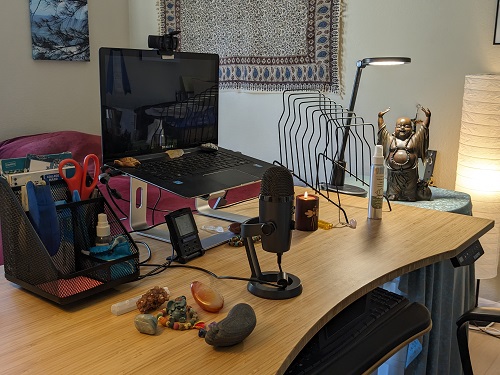
Having objects that have meaning for you in areas that you spend a lot of time in (such as the bedroom, your desk, the kitchen counters, your home gym area etc.) can help you connect to a deeper sense of relating to whatever you are doing. For example, I have rocks, crystals and other objects on and around my computer to help ground me and be a clearer channel during sessions and when I write. It also helps me remember the bigger picture when I’m doing tasks I might otherwise dislike (like taxes, paying bills, doing marketing etc.). Personalize this invitation in a way that makes sense to you.

4) Bring your breath and gratitude to what you’re doing

An easy way to bring more presence to whatever you are doing is to take a few deep breaths before starting. I also like saying “Hi” and “thank you” in my head to whatever I’m doing or whoever I’m interacting with (and “thank you, bye”) to mark the start and beginning, and to tap into gratitude. That may be appreciation for myself, or for whatever the activity or interaction is bringing me.

5) Be in the process rather than the outcome

Again, this is both self-explanatory but also counter-cultural. We have been trained to “keep our eye on the prize” and always focus on our plans and goals. And while that might help us with our accomplishments, it often diminishes our enjoyment of our lives and what we do have, since we end up focusing all our energy on what is currently missing. In truth, being process oriented and reaching our goals doesn’t have to be mutually exclusive. In fact, I’ve found that when I’m in the moment-to-moment unfolding of experience, following where the energy is rather than pushing things with my mind, I manifest what I want much more easefully, and sometimes way beyond what my brain thought was possible.

6) Focus on the deeper meaning of the moment

When we are rushing from one thing to the next, it is easy to take things for granted, or see things/people as a distraction. Which can create a general feeling of frustration, dissatisfaction, and—further down the line—regret at not realizing what we had. If we slow down and get out of “ticking things off our list” mode, we can remember to appreciate whatever is in front of us. Paying a bill is an opportunity to be grateful for whatever it is providing us. Going shopping, we can appreciate we have the money for and access to nourishing food. Showering can be a ritual cleaning activity, and so on.

7) Make it simple (and everything can be sacred)

If you like elaborate rituals and have time for them, by all means do that. But most of us get overwhelmed if something feels too difficult, and then we don’t do it. This does not have to be complicated. Do whatever feels accessible, easy, and enhances your enjoyment of life.

Life as Sacred Ritual

Give yourself space

Spread your wingspan
to full capacity

Out, out, out…

till you touch
the immensity
of possibility
when you live
in Infinity

The only limits
are self-generated,
trauma perpetuated

B R E A T H E
your lungs

out, out, out…

beyond distorted prisms,
twisted stories
imprisoning potentiality

E x p a n d
into the
unknown

Elevate drudgery
into art

Make the mundane
a sacred ritual

Reclaim sovereignty
over experience

Let the mystery
dissolve matter
until you float
in the bliss
of beingness

© Jenny Brav


Making the Mundane Sacred *2024-05-20T14:26:08+00:00

Step into your Bigness*

“Our deepest fear is not that we are inadequate. Our deepest fear is that we are powerful beyond measure. It is our light, not our darkness, that most frightens us” – Marianne Williamson

In a recent session, a client who has chronic physical pain saw herself unzipping the small, narrow suit she has been trying to fit into since her childhood, and stepping into a big, unlimited self. Her big self (which can also be seen as her essence, or whole self) was free from old patterns of either needing to collapse to be safe, or fight back to try to assert her autonomy. Her body—and in particular her joints and nerves—had so much more space to breathe when it wasn’t trying to fit into others’ ideas of who she needed to be.

Although the degree can vary widely, all of us have been wounded. As a result, we developed beliefs and coping strategies to help us understand and manage those wounds. When our circumstances change, but our beliefs and strategies do not, the latter end up perpetuating the very thing they were designed to fight against. Crises (physical or emotional, internal or external) and feelings of stuckness are usually an indicator that a part of us is ready to grow and evolve, while another (usually younger) part of us is clinging to the old strategies for dear life, terrified of what the consequences might be if we let go. The way forward is for the young self to feel heard, held and acknowledged, while simultaneously realizing that the situation has changed, and that it’s safe to let go.

Here are five tips for accessing your bigness and stepping into your power.

1. Notice your small self

Start tracking what it feels like when you are triggered, reactive, or shut down. How does your body feel? What is your posture like? What are you believing about yourself and the world? Is there a pattern to what triggers you—such as feeling misunderstood, or like you don’t matter? I invite you to keep a journal for a week or more to take note of this.

2. Explore the origins

When we are triggered, we are usually filtering and reacting to the world through wounded child eyes, even though the arguments we use to justify our reactions may tap into our adult faculties of reasoning. When you are feeling reactive or collapsed, ask yourself “what age is associated with this response?”

If nothing comes up, I invite you think about your childhood. If there was an age when you started learning X (whatever belief you identified in #1), what age/ages might it be? It might also be a timeframe more than one age. What were the situations or the people you were learning that from?

3. Send compassion to your small self

Imagine that your adult self is with that young part of you. What would have been helpful to hear back then? For example, “It’s not your fault.” “I’m proud of you.” “You’re not alone anymore, I’m here.” “You did exactly what you needed to do.”

If it feels appropriate, imagine that you are projecting images of your current life to your young self/selves. Let them know that their situation isn’t going to be like that forever, that things are going to change, and that you have resources they didn’t have.

4. Step into your big self

I invite you to close your eyes, and feel back into that feeling of a small self. Imagine that in front of you is your big, wise, essential self. If that’s hard to call up, you can also bring in a powerful energy/being you feel resonance with. For example a tree, a tiger, a mountain, a spiritual teacher or religious figure. Visualize yourself unzipping your small self, and stepping out of it. You can do that as slowly as you need to, over several days or week if necessary. When you are ready, feel yourself merging with your big and wise self and/or with the powerful being you called in. Notice what that feels like in your body. What does the world feel and look like when you look at it through your wise self eyes? Once you feel somewhat comfortable with this big version of you, you may want to bring up a person or a situation that has felt problematic to you. Does looking at it through these eyes shift your perception?

In a recent session, a client of mine merged with mountain energy. When she looked at people who had always been intimidating to her young self through mountain eyes, they seemed much smaller. She could see how they were trapped in their own pain.

5. Creative depiction

I invite you to find a creative way to further anchor this version of you into your body and subconscious. When I say creative, I’m referring to whatever way you have of accessing a deeper part of yourself. You could do this as a guided meditation, or feel yourself stepping into your bigger self as you are hiking, walking, biking, running, swimming, paragliding… You can draw/paint it, write a poem on the theme, or dance the transition from small self to big self. You could do a body sculpture or mime it. A combination is also possible. I wrote a poem entitled “Ode to my small self,” drew a picture of myself shedding the old patterns and fully stepping into my essential self, and have been visualizing it in some of my daily meditation practices. Just in case the universe didn’t get it the first time.

I wish you luck on your journey, and feel free to leave a comment on how that went for you.

The following is a guided meditation for stepping into your wise self.


© 2020 Jenny Brav


Step into your Bigness*2023-06-20T11:50:38+00:00

Turning Down the Noise *

Do you feel like there’s never enough time for you? Would you like more space to connect inward?

“Disconnect from everything long enough to see if it feeds your soul or if it’s a distraction. What’s deeply connected will always remain.” – Maryam Hasnaa

When we are caught up in the external noise of life (family obligations, work, distractive habits etc.), that generally means we are out of attunement with ourselves. This may be expressed as anxiety, fatigue, lack of self-care, irritation or depression—to name a few. In order to come back into harmony with ourselves, it’s necessary to turn down the outside noise. The following are a few suggestions for how to do that.

1) Technology detox
One of the most common forms of distractions these days is technology. Reaching for our phones is such an easy way to pass time and avoid feeling. A few months into the pandemic, I realized that my body and nervous system were impacted by the sudden shift to being online so many hours a day (for work, entertainment, socializing, exercising…). I started implementing a monthly internet-free weekend, which has been so helpful for resetting my nervous system. The last weekend of the month, I turn off my wi-fi and phone Friday evening, and turn it back on Monday morning (checking my phone once on Saturday and Sunday morning to make sure there are no emergencies). I do longer than usual meditations, journal and connect to my inner guidance, spend more time in nature, have quality time with my cat, write, and so on.

Some of the benefits are: deeper connection to self and to my intuition; feeling more present and focused; getting better sleep; slowing down; getting perspective on my life. While I know not everyone has the luxury of being able to do exactly what I described, there may be a way to adapt some part of it to meet your needs.

2) Minimizing Numbing/Distractive habits
In addition to technology, there are many habits that disconnect us from ourselves. This includes any addictive behavior (alcohol/drug consumption, food, shopping, gambling, sex/porn, compulsive thoughts and so on). While these behaviors are symptoms that something is needing loving attention, finding ways to minimize the behaviors can be helpful to make space to tune in. One of my clients has found the “Days Since” app helpful to track habits she’s wanting to do less of.

Conversely, it may be helpful to tune in (#3), give yourself compassion (#4), and start with nourishing habits (#5) before trying this one. Sometimes the distractive habits shift on their own when we are implementing the nourishing ones. Feel free to experiment and/or trust your intuition of what works for you.

3) Tuning in
I invite you to spend a little time every day (ideally) or week (depending on your time), tuning in with yourself. That can be through dance, spending time in nature, sitting in silence, journaling, painting, stretching… anything that helps you connect inward. This is best if the focus is on the process and not the outcome. In other words, you’re not trying to paint or write something “pretty,” or stretching to meet a fitness goal. While that is fine, it’s rarely conducive to a true tuning. Listen for any emotions or part that are feeling vulnerable and wanting loving attention (such as grief, fear, insecurity, anger, and so on). This could also be neglected parts such as your creativity and inner knowing.

4) Loving presence
Once you have connected with some part of you wanting loving attention, I invite you to spend some time bringing presence to it. That might be through putting your hands on your body (for example on your heart and/or belly). Doing a loving-kindness meditation. Saying affirmations. Breathing or humming. Whatever feels natural and good. Kristen Neff and Tara Brach are two spiritual teachers with many resources for self-compassion. EFT for self-acceptance can be helpful, as well.

5) Making Time for Nourishing Habits
Make a list of habits that you know are nourishing for you. You can either do this concurrently or once the parts are (hopefully) feeling more seen and heard. This can include any of the ways you used to tune in. And commit to doing one that feels manageable once a day for a minimum of 3-5 minutes. It doesn’t need to be anything big. I’ve found that 5-10 minutes of silence, stretching, and self-massage to start the day and/or close the day can have a profound effect on my clients’ feelings of well-being.

The Space in Between

The space in between
is where it all begins

The gap between words
The silence within speech
The pause from one foot to the other
The stillness within the inner storm
The breath spreading out the time
between thoughts

This is the ground of our being
where solidity dissolves
into infinite              space

This noise we call life
merely veils the two-winged path
of wisdom and compassion
that gives flight to the heart


© Jenny Brav

Turning Down the Noise *2023-03-23T10:47:32+00:00

Embodiment Ritual *

Do you have a difficult relationship with your body? Do you live more in your head than your body? Do you often check out or disassociate? Are you struggling with a chronic illness or pain? If so, an embodiment ritual might help bring your spirit, mind and body back in alignment.

“Enlightenment needs embodiment. Wide-open insight needs deep-rooted instinct. As above, so below” –Kris Franken

From the get go, 2022 was a difficult year for my body. On January 9th, a car ran over the back of my heal, and the wound got infected. I was diagnosed with a connective tissue disorder (h-EDS) in fall of 2021, and tests that I did for that revealed I had was suffering from mold toxicity. This led to months of detoxing, more testing, and negotiating with my landlord (and eventually getting the mold remediated in the fall). I fell and dislocated my shoulder (which I’m prone to, but hadn’t happened in 13 years). A moderately bad case of covid in the summer exhausted me and weakened my lungs…
Embodiment and reconciling my spirit (which would be happy floating as light) and body has been a long-term intention of mine, and was one of the reasons I moved to the Bay Area in 2010 to open a holistic healing practice. With everything happening, however, I found myself resisting being in my body, slipping into old distractive habits. For my birthday in December, I decided to create an embodiment ritual, which I did at Muir beach in Marin, CA. In the rest of the blog post, I’ll be describing what I did/said, and ways you might be able to adapt this to your needs. In terms of location, the ritual can be done anywhere, as long as it’s a place you feel ease in, and there aren’t distractions. If indoors, setting up the space in a way that feels special to you (that can be with music, candles, at an altar, etc.) may be supportive.

Pre-ritual clearing of grief or fear.

If there’s pain, grief or fear when you think about embodiment (or being more in your body), then this might be a helpful precursor to doing the ritual. You can write down or name out loud what you are afraid of or grieving, and then give it to something outside of yourself. This can be a guide, an element, God/Goddess, your higher/wise self, the universe…

Mine was grief at what I’d been through that year and how it had changed the intentions I’d originally had for it:

I give my grief to the ocean, the sun, the wind and the sand.

To the ocean: may you take me to the depths of my sorrows, cleanse me of the old stories and contracts, and bring me back to the surface, for the

Sun to warm my heart, dry my tears, return me to the brightness of my own spirit,

For the wind to fluff out my aura and my wings, and remind me I was born to fly

For the sand to show me support that is both soft and firm, yielding and loving

For this part, you can also do my “Tapping on blocks to Embodiment” video (see below).

Embodiment Ritual

This is intended as a reconciliation practice between two or more parts that feel split and/or at odds. That may be your mind and body, your spirit and your body (as in my case), your heart and mind. It may also be a combination of all three. I find it helpful to use objects that symbolize both. I found a shell for my spirit, a jagged and unique rock for my body, and then another rock that had aspects of both for what I wanted to birth from the union. You can also write words, find images, make a drawing, dance or sing each one, or whatever your natural expression is.

  1. Gratitude

Here, I took the opportunity to express my gratitude to each part. You can also have the two parts express gratitude to each other. For me, that was blended into their apology.

For my spirit:

I love your ability to fly. How brightly you shine. Your fairy nature. The compassionate heart that wings your flight. Your connection to source. The way you help others find their light. Your eternal optimism.

For my body:

I love your sensitivity and attunement to the world around you. I love your patience and forgiveness when I push you too hard. I love how much you try. Everything you do for me despite the lack of connective tissue support. You are a wonderful companion for me, a beautiful reflection of the spirit you’re a temporary refuge for.

  1. Repair

This is an opportunity for you to do any repair that might feel helpful with either or both parts. And, if it feels relevant, for them with each other. Again, I’ve included my words for inspiration, but please adapt it to what feels appropriate for you. Although I’m an amalgam of my body and spirit, for me there was a difference between what I wanted to say to each, and what they had to say to each other, but that might not be the case for you.

Me to my spirit:

I’m sorry if I’ve turned away from you in my pain, if I’ve stopped trusting you or believing in you as much. For the times I’ve checked out and abandoned you.

Me to my body:

I’m sorry for abandoning you when you needed me the most. For not prioritizing taking care of you. For taking you for granted and neglecting you.

Spirit to my body:

I’m sorry for undervaluing you. Resenting you. Thinking you weigh me down. Holding past traumas against you. For forgetting what a gift it is to be in a body. That embodiment was my choice because how else will I hear the ocean, feel the sun, dance, know the joy of touch, taste delicious food…

Body to spirit:

I’m sorry I forget I am not all there is. That I get so caught up in the toil and pain of being a body that I stop believing in you. That I don’t turn to you for healing.

  1. Vows

Here, each part is expressing what they are vowing moving forward. I expressed these as one would in a sacred ceremony between two people who love each other might, but again, you can do this in whatever way feels aligned for you.

Spirit to my body:

I vow to honor, love, cherish and respect you as my chosen companion.

Body to my spirit:

I vow to remember you are my eternal companion. To let you carry me through the burdens of this life. To keep releasing the traumas—both mine and inherited.

My vow to both:

I vow to do my best to stay present in the pain. To honor and make space/find support for my grief. To continue tapping into spirit and source to lift us up as often as possible. To cherish and nurture my body, to love it unconditionally rather than trying to fix/make it better. In sickness, in health, in joy, in sorrow.

  1. Naming what you want to bring in

This part is an opportunity for you to name what you want to birth for yourself through this union/reconciliation between the two or more parts.

From this union, I’m birthing balance. Joy. Trust. Ease. Slowness. Stretching. Embodied wisdom. Limitlessness. Being a beautiful, graceful bridge between worlds. To thrive in co-empowered relationship.

© Jenny Brav


Embodiment Ritual *2023-02-23T10:49:25+00:00

Cultivating Greater Self-Love and Acceptance *

Can you be your own worst critic? Is loving and accepting yourself contingent on changing all the things you don’t like about yourself?

“The most terrifying thing is to accept oneself completely.” – C.G. Jung

In Emotional Freedom Techniques (EFT, or tapping), the standard setup sentence is a variation on “even though I have [_____ fill in the issue you are working on], I deeply and completely love and accept myself.” For many of us, however, the idea of loving ourselves as we are seems like science fiction.  This may due to a history of receiving praise or rewards for good behavior or achievement, and of getting negative feedback/punishment for misbehavior or under-achieving. We may also have learned that loving ourselves was tantamount to arrogance.

In the healing world and spiritual realms, however, it has become accepted wisdom that whatever we resist persists, and that the gateway to change is actually being able to accept ourselves as we are. Easier said than done, for many of us.

The following are 8 tips for cultivating greater self-love and acceptance.

Note: For some people, the word love itself is a loaded term. Clients sometimes say: “I don’t even know what the word love means!” If that is the case for you, you can replace the word love with acceptance, empathy, or any other word that resonates with you.

# 1 Notice your self-judgments

For the duration of this article, I invite you to take off the hat of self-critic, and put on your curious explorer hat. Imagine that you are an anthropologist newly arrived in the land of You, who is wanting to understand what makes you tick. With that perspective in mind, I invite you to start noticing what gets in your way of accepting yourself. Are there specific themes or patterns to your self-judgment? For example, does your self-critic get activated about your appearance, your performance, your articulateness, an addictive habit, your productivity, your ability to socialize with others? Do you ruminate about the past, or compare yourself to others?  

I recommend keeping a daily judgment journal for a week. Either as you go or at the end of the day, jot down the thoughts and self-criticisms you noticed coming up during the day, or any way you felt disappointed in yourself. If self-judgment is not the main obstacle to loving yourself (but rather an addictive behavior, being too other-focused, and so on), track that instead.

#2 Notice the impact on your body and emotions

Now that you have a sense of what your judgment patterns are, start noticing what happens in your body when you judge yourself. Do certain areas of your body contract? Are those habitual areas of holding for you? What emotions arise when you are hard on yourself? Do you feel shame, frustration, helplessness, anger, overwhelm, defensiveness and so on? Do you want to check out? After a few days of tracking your judgments, start adding the physical and emotional impact of your self-criticism in your judgment journal.

#3 Acknowledge your patterns for trying to help you

Ask yourself what your judgment is trying to achieve for you? Is it wanting to motivate you to do better? Get you to change a negative pattern of behavior? Do better than those around you? Prevent you from experiencing failure by keeping you from trying?

Send gratitude to your judgment and self-critic for what they are trying to achieve for you. And then ask yourself how well it’s been working for you. Does judging yourself actually motivate you to work harder, or does it just lead to feeling bad about yourself and wanting to give up? And is there another way to meet the same need that might be more effective?

#4 Trace the pattern to its roots

After a week of keeping your journal, start feeling into the beliefs about yourself that might be underlying your judgments. For example: “I always mess things up,” “no matter how hard I try it’s never enough,” “it’s OK for others but not for me.” Start noticing if the belief feels familiar. Ask yourself: “if there was an age when I first started believing this, what age (or time frame) might that be?” And see if any number or memory pops up. If not, do not worry about it, you can just stay with the belief itself. Otherwise, start feeling into what was happening at the time, or who you might have gotten that belief from. Whose voice or judgments (either about you or themselves, or both) might you have internalized?

#5 Send yourself compassion and forgiveness

Now that you have identified where some of your patterns come from, see if you are able to give yourself compassion for the messages you might have received about yourself. If you aren’t able to have compassion for your current self, try sending empathy to your younger self. At the same time, begin to open to the possibility of forgiving yourself for having absorbed these messages. If you have regret over the past, things you did or didn’t do, see if you can forgive yourself for that, too. Realizing that when you withhold love from yourself, you are likely to perpetuate the mistakes you are beating yourself for. Remember that accepting yourself doesn’t mean giving up or resigning to an unwanted fate. It just means that you are no longer fighting with what is. In fact, it is often only when we are truly able to be love ourselves unconditionally that old stuck patterns begin to shift, because it was conditionally of love that made us develop the coping strategies in the first place.

#6 Start welcoming the parts that have been rejected

As you begin to give yourself compassion, begin to feel into the possibility of accepting even the parts of you that seem unacceptable. Most of us make self-acceptance conditional on living up to our expectations of ourselves, which means that we split off from parts of ourselves that feel unworthy of love. However, those neglected or hidden parts often manifest as our shadow or self-sabotage patterns, trying to get our attention. The more we are able to embrace all of ourselves, including the parts we are less than proud off, the more likely we are to feel whole and integrated.

Feel into the parts of yourself you have been judging. It may be your fear, your vulnerability, your anger… Or it may be the part of you that shuts down and goes into overwhelm, or the part that wants to check out and distract. And see if you can start welcoming that part in. If it helps, perhaps put a hand on your body where it felt tight earlier. And give that part reassurance. For example “it’s ok. I’m here. Even though I’ve been angry at you, I’m open to accepting you are here.” Or whatever feels genuine to you.

#7 Honor your strengths

Our minds are conditioned to focus on the negative. In order to begin shifting your perspective, I invite you to start making a list of your strengths. Transform your judgment journal into a gratitude and celebration journal. Every day, write down something about yourself that you want to honor, and/or that you are grateful for.

#8 Connect to your future self

If accepting and loving yourself as you are still feels elusive (and even if it doesn’t), I invite you to call in a future self who is at peace with themselves. You may get an image of them, or just a felt sense. Imagine that you are approaching this version of you, and letting them know that you are struggling with accepting yourself as you are. Ask for any message or advice they may have for you to get to where they already are. You may also ask for their support in helping you heal any remaining limiting belief or outdated coping strategy that may be getting in your way. If it feels accessible, imagine you are merging with this version of you. How does it feel in your body to accept yourself? How are you living your life? Feel this in every cell of your body. Feel yourself embodying this version of yourself every day for 21 days, and by the end of that time you are likely to feel more at peace with yourself. 

“Once we believe in ourselves, we can risk curiosity, wonder, spontaneous delight, or any experience that reveals the human spirit” – E.E. Cummings

© Jenny Brav


Cultivating Greater Self-Love and Acceptance *2024-04-02T12:24:31+00:00

Healing Childhood and Family Wounds*

Do you feel like your childhood wounds are still interfering with your life? Does being with and/or thinking about your family trigger strong reactions in you?

“When we’re all living in the space of the inner child, loving, honoring, respecting, and embracing its desires, we are at peace.” Kim Ha Campbell

Most of our core wounds come from our childhood experiences. We might have gotten the message that we were too much, not enough, that parts of us weren’t acceptable and had to be hidden. We may have experienced neglect, abuse or other forms of trauma. The beliefs and coping strategies we developed as a result often stay with us long after our circumstances have changed.

Whether we are still in touch with our family or not (and whether our family members/caretakers are alive or not), the holiday season and certain anniversaries can be triggers for all that old stuff to come to the surface. Similarly, the old patterns often rear their heads when we are on the cusp of big transitions, and one part of us (usually the current, adult self) is ready to change, while another part (usually a very young self) is terrified and thinks change means certain death.

The following are five tips for beginning to heal childhood and family wounds:

1. Identify the wounds

Most of the time, we are not even aware of the old programing that is still running our thoughts and our nervous systems. Something happens, and whatever we are feeling and thinking feels like the truth: we are being dismissed, or victimized. Others really don’t care and can’t be trusted. However, these are just beliefs, the lens through which we are interpreting events. The first step is therefore to identify what the wounding and the beliefs are.

Is there a feeling or thought that is often recurring for you? For example, do you have a story that you are not welcome, or that nobody sees you? Perhaps think of a recent situation that triggered a strong reaction, or a difficult interaction with a family member. What were you believing about yourself or the other in that moment? Examples include: “I don’t matter,” “I’m invisible,” “others’ needs matter more than mine,” “I can either honor myself or please others, but not both,” “showing vulnerability is weak, and others will take advantage of me…” Write down your belief.

2. Feel into the emotions

To go more deeply into the wound, I invite you to notice what emotions come up for you when you are believing the words you wrote down in #1. These might include sadness, frustration, helplessness, rage, fear, confusion and so on.

When you access these emotions, check in with your body and notice the physical sensations there. Does any area get tight, achy or jittery? Does any part of your body (or perhaps even the whole body) feel distant or numb? There is no need to try to fix or change it, we are simply exploring and getting curious about what is there, what is wanting our attention.

3. Trace the belief and feelings back in time

Closing your eyes, imagine that you are following the belief, emotions, and physical sensations back in time, to a time, situation or place when you first or most significantly felt something similar. You might get a memory, or just a felt sense of something. You might also access a time period more than a specific incident. What was happening at the time? How was your young self feeling? What was he/she learning about him/herself and the world? What was s/he deciding to do to cope with the situation?

4. Bring love and healing to your young self

The wounding happened because your young self was needing something he/she didn’t get. Common unmet needs include safety, connection, feeling seen/understood, feeling that our voice matters and so on. The best way to begin healing the wounds and upgrading our coping strategies is to start offering that missing experience to the young self. What were they needing that they didn’t get?

Once you have a felt sense of your young self, imagine that your current self is entering the space with your young self. Let them know you are there to support them. Say something to them that would have been really helpful for them to hear at the time. “It’s not your fault.” “I’m here, I’ve got you.” “You are perfect exactly as you are.” “Their inability to be there for you in the way you need reflects on them, it has nothing to do with your needs.” Or if what your younger self is needing is physical presence more than words, you can feel yourself holding that part of you, giving him/her love.

 5. Start imprinting new possibilities

Give your younger self an energetic hug. Let them know you will keep on checking in on them. Now imagine that you are fast forwarding in time to a time when you have released that belief about yourself and/or the world. You realized that it was just a belief you developed when you were very young as the best way you could make sense of your experiences at the time. It’s not the actual truth.

What new belief would you like to replace the old one with? How are you feeling and living your life with this new programming? Feel and imagine it in as much detail as possible. And if it doesn’t feel accessible yet, keep doing the first four suggestions until it does. When you are ready, visualize yourself dropping this image of you operating on this new belief into your crown, and letting it permeate all the neural pathways that have been conditioned to the old belief. Feel it spreading to all the cells, muscles and tissues in your body. Placing your hands on your heart, imagine you are filling your heart with this new belief. When your heart feels full, feel it radiating back out into the universe.

The following is a guided meditation for healing your younger self based on the above tips:


© 2019 Jenny Brav


Healing Childhood and Family Wounds*2023-07-11T11:41:30+00:00

Staying Centered in Times of Uncertainty*

Do you feel like your world has been thrown off balance? Have some of your old triggers and patterns been activated in the past few weeks (or perhaps months)?

“We don’t realize that, somewhere within us all, there does exist a supreme self who is eternally at peace.” ― Elizabeth Gilbert

monument-valley-1593318_1280

For most of us, change and uncertainty—whether it be on an individual, community, national or global level—triggers our old wounds and coping strategies. This may look like overwhelm and paralysis, getting easily irritated, trying to manage and control things…While it may feel like we have regressed or there is no solid ground to cling to, in my experience this is a sign that we are shifting into new possibilities, and that our souls are shedding what no longer serves us. That doesn’t mean it’s comfortable, however!

The following are five tips for staying centered during chaotic or uncertain times, so we can come out on the other side relatively unscathed.

# 1. Pay attention to your patterns

When things are feeling unpleasant, many of us have default patterns we rely on. You might notice you have an emotional response such as getting angry, blaming others, or collapsing into doubt and defeatism. Or you may find yourself falling back on your favorite distraction strategies to avoid feeling, or to comfort yourself. These may include over-eating, binge-watching Netflix, playing video games, watching porn, compulsive thinking, exercising frenetically, and so on. For now, simply take note of what is coming up for you, without making yourself wrong or trying to change your behavior.

# 2. Connect to your body

During times of change, many of us go into fear mode and disconnect from our bodies (as you might see from the patterns you have been tracking).  I invite you to find small ways to connect to your body, especially if you are feeling activated. Ideas for this include (but are in no way limited to):

  • Spend time (even 5 minutes) meditating and feeling your breath
  • Take a walk out in nature
  • Garden
  • Engage in a physical activity
  • Pat your body all over, and really feel each part as you touch it
  • Allow yourself to feel the feelings that are coming up

Whatever you do, keep bringing your attention back to your body, so that the activity isn’t just another way to escape from feeling.

# 3. Reach out to others

During these times, many of us (especially those on the more introverted spectrum) tend to isolate and hunker up. While having more space to connect to yourself can be healing right now, notice if isolating is exacerbating your sense of inertia/despair. If it is, be sure to reach out to those you are close to and trust. Know that you are not alone. There is a big energetic shift that many are feeling in this moment. This is a good time to reach out to healers or therapists you may have seen in the past, as having support is key right now.

# 4. Be gentle with yourself

I invite you to be very gentle with yourself, whatever is coming up. If you are struggling and reverting back to old patterns, then in all likelihood your inner critic is having a field day with you (because that’s our inner critic’s job)! In addition to noticing your patterns, connecting to your body, and reaching out for support, I suggest you give yourself as much empathy as possible. A beautiful Buddhist practice for that is that of loving kindness, also known as Metta. This is a practice where you send yourself loving intentions for your well-being, such as “may I be happy, may I be safe, may I be healthy, may I live with ease…”  (click HERE for more information on the practice). If it is difficult to send yourself love, you can start with someone you can easily give love to (such as a pet, child, or loved one, and then start giving it to yourself.

“We can never obtain peace in the outer world until we make peace with ourselves.” ― Dalai Lama XIV

   #5. Open up to what wants to emerge

Tips 1-4 should help get your body out of survival (or fight/flight) mode, meaning that you are feeling calmer, more at ease, and your nervous system isn’t as activated. If not, keep doing more of the above. If so, you can set the intention to start opening to what wants to emerge. This may take the form of asking yourself, from a calm and peaceful place: “what am I supposed to be learning from this?” or “what is wanting to emerge?” and just see what happens next. Or if you have a practice of checking in with a higher power, guides, or your higher self, you can do so and see if you get any message or advice. And remember, you are not alone.

Words of encouragement for tough times 

Finally, I will leave with a few words of encouragement I wrote for my loved ones during a time of crisis:

Know that even when the shadows are dancing in the corners of your mind, you are loved.

That even when the doubts crowd your knowing, you are supported.

That hope is waiting to pull you out of the undertow of despair and disparagement.

That when you are lost in the wilderness of your pain, your light is still there, even if hidden.

And when your breath slows its frenzied race, it can reignite your soul with its loving touch.


© Jenny Brav

Staying Centered in Times of Uncertainty*2022-07-30T19:13:28+00:00

Navigating Cycles of Death and Rebirth *

Do you feel heavy, exhausted, or stuck? Is some area of your life in crisis, or simply feels like it no longer fits?

“How can you rise, if you have not burned?” – Fatima Ahmad Ibrahim

Have you ever noticed that, when viewed in hindsight, the darkest times in your life are often followed by a sense of renewal or growth? In Shamanic terms, cycles of death and rebirth refer to periods in our life when part of us—be it a belief, a coping strategy, or situation—is ready to die in order to make way for a bigger version of us to emerge. However, the death part of the cycle can feel very uncomfortable when you’re in the middle of it, which is why I’m focusing on that part of the cycle specifically.

The following are possible indicators that you are in a cycle of death and rebirth, as well as four tips that might help you get through the death part of the cycle with more ease.

You might be in a death-rebirth cycle if one or more of these are present:

1. An area of your life (such as your health, finances, relationship, or work) is in crisis

This is often a sign that old patterns no longer serve us, but some part of us is hanging on for dear life, which may lead us into an acute situation.

2. Things feel dense, heavy and dark

Even when the situation is not acute, you might feel weighed down (physically and/or emotionally), and have the sense of wanting to shed something. This could lead to feeling stuck, depressed, lethargic, or irritated/frustrated.

3. You feel like you’re regressing into old patterns

Although this one might feel counter-intuitive, one sign that you are on the cusp of a rebirth is the resurgence of old patterns. This is often the case because whatever young part developed the pattern you are ready to shed is scared and doesn’t know it’s safe, so there’s some backlash to the changes wanting to occur.

4. You’re feeling anxious, and like there’s no ground beneath you

Especially if you have chronic anxiety, these periods of transition will probably trigger fear and agitation. It is important to remember that your anxious thoughts are not telling you the truth of your situation, but are merely indicators of a part of you needing love and attention.

Four tips for cycles of death and rebirth:

1. Identify what you are sloughing off

If one of the above indicators resonates with you, I invite you to get curious about what might be wanting to shift. I.e. if an area of your life is in crisis, what might it be pointing to that’s wanting healing. Is it a belief about yourself or the world? A way of being in the world that no longer fits (such as people pleasing, or needing to be right…)

Although not absolutely critical to the process, it can be helpful to name what it is that you might be letting go of, such as: a pattern of distraction and checking out; a strategy of staying small and under the radar; the need to fight for attention; the belief that you’re all alone…

2. Bring loving attention to the scared/resistant (younger) parts

Once you identify what you’re letting go of, feel into any young part that might be scared, or resisting. Is there an age/age range or memory associated with the patterns? If not, no worries, you can just focus on the feelings.

Send compassion to the part of you that is scared or resisting. This could simply mean putting a hand on a part of your body that feels tight, agitated, numb, or achy. Or you could say some caring words such as “I know it’s scary. Of course it is. This is reminding you of all the times you got the message it wasn’t safe to… And we can hang onto this as long as we want to. And, it’s possible it is safe. We are ready. We have more resources and choices than we did then…”

3. Make space for grief

Just because it’s in our highest interest to grow and evolve doesn’t mean there won’t be grief about letting go of old and familiar patterns and beliefs. It’s important to be gentle and patient, and to make space for grief.

4. Trust

We tend to interpret the death cycles as wrong and bad, which is understandable because they can feel so uncomfortable and/or dire. However, that only leads to resistance and  fighting with what is, which prolongs and exacerbates the discomfort. Once you start learning to identify these patterns, you can begin to trust and surrender that whatever is happening is for your highest good.

And even if you don’t know what that is, you can trust that further down the line, when viewed in hindsight, these dark times will be followed by a sense of renewal or growth.


 © Jenny Brav

Navigating Cycles of Death and Rebirth *2024-02-27T15:05:07+00:00

Inviting in Fun and Play

Does life often feel heavy and overwhelming? Do you wish for more flow and ease?

“Play is the only way the highest intelligence of humankind can unfold” – Joseph Chilton Pearce

“We don’t stop playing because we grow old; we grow old because we stop playing.” – George Bernard Shaw

Whether there was space for fun and play when we were children or not, most of us learned that by the time we are adults, it’s time for us to get serious. That wanting to integrate play into our lives is immature and irresponsible. However, a number of studies and books have explored the importance of play for adults, such as Dr. Stuart Brown’s book Play: How it Shapes the Brain, Opens the Imagination, and Invigorates the Soul. In fact, play can help improve our memory, our ability to connect to others, and can mitigate the effects of depression and anxiety.

The following are 6 tips for inviting in more fun and play into your life, and also understanding the difference between play and behavior that may be self-sabotaging/addictive.

1) Identify beliefs about life/work/being an adult

On a scale from 1-10 (10 being the highest), how would you rate the amount of fun and play you integrate into your life? And remember that rating isn’t about good/bad or right/wrong, it’s just information for us to be able to better assess and understand the kind of life we want to be creating for ourselves.

If the number is low, ask yourself what messages you received as a child about life and work. Were the adults in your life having fun and enjoying themselves? And if they were, was it in a way that was contagious and joyful for those around them, or in a way that could be neglectful and harmful to you and/or others they loved? You might want to write down some of these beliefs and experiences.

2) Clear childhood wounding around play/creativity

There are many ways we may have been wounded around play and creativity. Some of us had a lot of space to play and be creative as children, but find it difficult to integrate that into our adult lives (or to know how to balance play and work). Others of us have wounding around play and creativity, either because of the messages we received that we weren’t good enough/it wasn’t a serious activity to engage in, or because the conditions we were growing up in didn’t provide space for it. Play can feel like something only the privileged have access to. Bullying experienced at school and other forms of trauma can also be associated with recess and “play time.”

I invite you to feel back into that younger self. If it is accessible, send him/her/them empathy for those messages and experiences you identified in #1 and #2. Let them know that you are sorry they had to go through that. That you are proud of them for developing the coping strategies they did in order to survive. Let them know that you are doing everything you can to allow them to have a different experience now. That it’s possible life can be both fun and intentional.

3) Understand the difference between play and addictive behavior

Some of us learned (or had modeled for us) ways of dealing with overwhelm and the seriousness of life by checking out, or indulging in behavior that might on the surface of it seem fun, but is actually getting in the way of feeling whole and self-actualized.

Although there are exceptions to the following depending on the beliefs we have, in general, one of the differences between play and addictive behavior is how present we are during, and how much it feels like a choice. When we engage in addictive and/or self-sabotaging behavior, it often feels like we don’t have any control over our behavior, and some part of us feels split/ashamed about our behavior. There may also be guilt and shame about play and fun that is nourishing to our soul too if we learned it was irresponsible to have fun, for example. But that kind of guilt usually has more of a nagging quality.

The point is not that one is good or bad. We want to thank the pattern/behavior we have developed for its intention – for example, to prevent us from feeling uncomfortable emotions or to honor our right to have fun. And start bringing in the possibility that there are other ways to meet those needs.

4) Write a joy list

I invite you to make a joy list to help identify what makes you happy. For example, singing, reading, dancing, building things, making art, going to the gym, star gazing, camping, gardening, riding a motorbike, cooking, listening to music, and so on.  If there are things you loved doing as a child which you have stopped doing, you may consider adding those as well. For many of us, life starts feeling a little sterile when we are always doing the same things. Your joy list could include doing something new each week. If you spend a lot of time in your head for work, then doing something that includes the body might be a great way to hit the reset button.

5) Create a joy box/drawer

Looking at your joy list, put a star next to the top 5 that feel both doable and fun (or more if you wish). Write each one on a separate sheet of paper, and put it in a small box. Each week (or month), you can pick a different one, and commit to doing it in that time frame. Alternately, in her book “Simple Abundance: A Daybook of Comfort and Joy,” Sarah Ban Breathnach suggests creating a “comfort box” of things you can pull out on days where life looks bleak. It can include games, crayons, puzzles, stuffed animals, magazines, jokes and so on.

6) Create more time in your schedule

Now that you have your list, make space in your schedule. You may block off specific time for fun in your calendar. Or you might schedule “fun dates” with yourself, with friends or with a partner. And as with most things, it’s not so much the “what” as the “how” that’s important. You might consider the possibility that there is no way of getting this wrong.


Play is my soul coming home to roost.
It’s my nervous system rediscovering its right to feel safe,
And my essence reclaiming its innocence.
As I let go of shoulds and expectations
I find my way back into my body.
Knotted muscles unwind,
Loosening their iron grip on my bones.
I am home

© 2018 Jenny Brav

Inviting in Fun and Play2019-06-25T11:20:59+00:00
Go to Top