Making the Mundane Sacred *

“There is no mundane dimension really, if you have the eyes to see it, it is all transcendental.” – Terence McKenna

One of the invitations I have been receiving in the past months is to make the mundane sacred. By slowing down, and bringing both presence and reverence to each moment, we not only elevate our experience of life but also our own vibrational state. The current cultural norm of toxic productivity has us rushing from one thing to the next with our eye trained on the future while we frantically tick boxes off our list. This leads to: stress, burnout, emotional and physical tension, disconnection, depression and/or frustration and dissatisfaction.

On the other hand, when we really take the time and live each task or experience to its fullest, we are able to experience much more ease and joy in our relationships and our creative/professional endeavors. And we then naturally start sloughing off anything extraneous to our well-being and contentment.

Here are seven simple tips for making the mundane sacred (with a bonus poem at the end)

1) Slow down

While this is self-explanatory, most of us are conditioned to speed up and get really busy during the big, transitional times. However, the more we breathe, take breaks, spend time in replenishing activities (whether that be in nature, meditating, taking a bath/shower, creating art, gardening, working out, connecting with loved one and so on) the better we’ll be able to navigate things with ease.

2) Declutter/tidy your space

It is difficult to slow down and touch into gratitude/reverence when the space we’re in is cluttered. And our internal and external state often impact each other in either a positive or negative feedback loop. The invitation here is to start with what you are doing/where you are in the moment. If you are about to cook, make sure the kitchen counters are clear. Before you work, clear off your desk (more about that below). Planning a big spring cleaning/decluttering (although it may organically turn into that) is likely to overwhelm you and make you want to put it off, or clean from a rushed and contracted place. So start small.

3) Have ritual/grounding objects in your work/living space

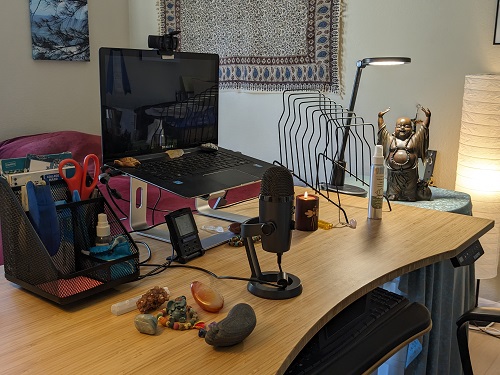
Having objects that have meaning for you in areas that you spend a lot of time in (such as the bedroom, your desk, the kitchen counters, your home gym area etc.) can help you connect to a deeper sense of relating to whatever you are doing. For example, I have rocks, crystals and other objects on and around my computer to help ground me and be a clearer channel during sessions and when I write. It also helps me remember the bigger picture when I’m doing tasks I might otherwise dislike (like taxes, paying bills, doing marketing etc.). Personalize this invitation in a way that makes sense to you.

4) Bring your breath and gratitude to what you’re doing

An easy way to bring more presence to whatever you are doing is to take a few deep breaths before starting. I also like saying “Hi” and “thank you” in my head to whatever I’m doing or whoever I’m interacting with (and “thank you, bye”) to mark the start and beginning, and to tap into gratitude. That may be appreciation for myself, or for whatever the activity or interaction is bringing me.

5) Be in the process rather than the outcome

Again, this is both self-explanatory but also counter-cultural. We have been trained to “keep our eye on the prize” and always focus on our plans and goals. And while that might help us with our accomplishments, it often diminishes our enjoyment of our lives and what we do have, since we end up focusing all our energy on what is currently missing. In truth, being process oriented and reaching our goals doesn’t have to be mutually exclusive. In fact, I’ve found that when I’m in the moment-to-moment unfolding of experience, following where the energy is rather than pushing things with my mind, I manifest what I want much more easefully, and sometimes way beyond what my brain thought was possible.

6) Focus on the deeper meaning of the moment

When we are rushing from one thing to the next, it is easy to take things for granted, or see things/people as a distraction. Which can create a general feeling of frustration, dissatisfaction, and—further down the line—regret at not realizing what we had. If we slow down and get out of “ticking things off our list” mode, we can remember to appreciate whatever is in front of us. Paying a bill is an opportunity to be grateful for whatever it is providing us. Going shopping, we can appreciate we have the money for and access to nourishing food. Showering can be a ritual cleaning activity, and so on.

7) Make it simple (and everything can be sacred)

If you like elaborate rituals and have time for them, by all means do that. But most of us get overwhelmed if something feels too difficult, and then we don’t do it. This does not have to be complicated. Do whatever feels accessible, easy, and enhances your enjoyment of life.

Life as Sacred Ritual

Give yourself space

Spread your wingspan
to full capacity

Out, out, out…

till you touch
the immensity
of possibility
when you live
in Infinity

The only limits
are self-generated,
trauma perpetuated

B R E A T H E
your lungs

out, out, out…

beyond distorted prisms,
twisted stories
imprisoning potentiality

E x p a n d
into the
unknown

Elevate drudgery
into art

Make the mundane
a sacred ritual

Reclaim sovereignty
over experience

Let the mystery
dissolve matter
until you float
in the bliss
of beingness

© Jenny Brav



Making the Mundane Sacred *2024-05-20T14:26:08+00:00

Letting Go of Your Old Stories *

Do you have stories about yourself or the world that define your life? Are there certain patterns that keep on repeating throughout your life?



When you hold onto a script that doesn’t serve you, you leave no space to write a new one that does.” – Jennifer Ho-Dougatz


Many of us have old stories or beliefs about ourselves and the world that rule our reactions and how we perceive things. We develop these beliefs in order to make sense of our circumstances, or in response to what others tell us. These beliefs or stories often enable us to overcome, or at least explain, difficult situations.

For example, a client who grew up in a war-torn country developed the belief that the world was a cruel place and that she could only depend on herself. This gave her the strength she needed to leave when she was 17, despite being terrified and alone. Decades later and living in very different conditions, however, this belief led her to fear and try to control the unknown, and was holding her back from thriving. Another client, who grew up in a large family with a mother who was overwrought with meeting the physical needs of her many children and couldn’t tend to their emotional needs, learned that his needs didn’t matter. Decades later, he would lose his sense of self in the face of his family’s demands, and was struggling to find his own identity.

The following are five tips for understanding and letting go of your old stories, so you can make space for new possibilities in your life:

# 1: Track recurrent patterns and internal conflicts
Whenever we experience patterns that keep on repeating themselves – be they in our relationships, work environments, or living situations – there is likely to be an old wound that’s wanting healing.

Start writing down conflicts or difficult situations you are currently dealing with or have in the past. Is there something familiar about this situation? Once you have listed some of your struggles, see if you can identify similar patterns that keep coming up for you. Track those patterns to determine if they occur most often in one type of situation (for example, at work or in your personal relationships) or if they are present across the board.

# 2: Make a list of your beliefs
Now that you’ve started identifying recurrent patterns in your life, I invite you to explore the beliefs about yourself that may be at the root of those patterns. One way to do that is to notice the stories and feelings that come up for you around the situations you listed in # 1. How do you feel? Invisible, like your needs don’t matter? Like others can’t handle you, that people are manipulative, that you are less than others? Next to the list of your patterns, start making a list of the beliefs about yourself and the world that you have identified.

# 3: Trace the beliefs back in time
Now that you have identified your beliefs, track them back in time to when you first started feeling something similar. What was happening at the time for you? How were you learning that your needs didn’t matter, or that the world is cruel, or that you would always be abandoned? They may have developed as a result of one traumatic incident, or of multiple similar incidents over time.

# 4: Acknowledge your story for its intention
We develop our beliefs and coping strategies for good reasons. And oftentimes, our automatic responses and ways of understanding the world were generated at a very young age. Send empathy to your younger self for the circumstances that led them to create the narrative they did at the time. If appropriate, also send acknowledgment to your story for having served you in some way. For example, it pushed you to try to be the best, or stay under the radar, or to put others first. And let your younger self know that your circumstances have changed, and that if you let go of the old story, they will be able to get what they most wanted back then but couldn’t have. For example, love, validation, the ability to be completely themselves.

# 5: Start writing your new narrative
Look at your list of beliefs and patterns. These are the unconscious blueprints with which you are running your life. It’s like a computer that’s still running on a very old operating system. And begin to write the new beliefs and new narrative you would like to have about yourself and the world.

When you feel the old story and feelings comping up again, I invite you to pause. Send your younger self love. Remind yourself that just because the old belief feels true (since you’ve been replaying this track over and over again for a long time) doesn’t mean it is true. And look over your list of new beliefs, picking one or two you want to focus on anchoring. Repeat this new belief to yourself whenever you notice yourself running the old program — until someday, this new belief becomes your new baseline.

Don’t spend your life believing a story about yourself that you didn’t write that’s been fed to you – that simply you’ve accepted, embedded and added to. Let the story go and there beneath is the real you…and your unique gifts, heart and path that await you.
– Rasheed Ogunlaru

Unraveling Old Stories

I unravel the old stories
Reified into my veins as truth.
As I untangle gnarled knots
Of “I can’t” and “not enough,”
Of overwhelm and anxiety,
They stream out
In colorful garlands
Of ease, trust, and adventure,
Paving the way
To new horizons —
Free from the fetters
Of my past.

© Jenny Brav


<


Letting Go of Your Old Stories *2023-12-31T19:11:36+00:00

Step into your Bigness*

“Our deepest fear is not that we are inadequate. Our deepest fear is that we are powerful beyond measure. It is our light, not our darkness, that most frightens us” – Marianne Williamson

In a recent session, a client who has chronic physical pain saw herself unzipping the small, narrow suit she has been trying to fit into since her childhood, and stepping into a big, unlimited self. Her big self (which can also be seen as her essence, or whole self) was free from old patterns of either needing to collapse to be safe, or fight back to try to assert her autonomy. Her body—and in particular her joints and nerves—had so much more space to breathe when it wasn’t trying to fit into others’ ideas of who she needed to be.

Although the degree can vary widely, all of us have been wounded. As a result, we developed beliefs and coping strategies to help us understand and manage those wounds. When our circumstances change, but our beliefs and strategies do not, the latter end up perpetuating the very thing they were designed to fight against. Crises (physical or emotional, internal or external) and feelings of stuckness are usually an indicator that a part of us is ready to grow and evolve, while another (usually younger) part of us is clinging to the old strategies for dear life, terrified of what the consequences might be if we let go. The way forward is for the young self to feel heard, held and acknowledged, while simultaneously realizing that the situation has changed, and that it’s safe to let go.

Here are five tips for accessing your bigness and stepping into your power.

1. Notice your small self

Start tracking what it feels like when you are triggered, reactive, or shut down. How does your body feel? What is your posture like? What are you believing about yourself and the world? Is there a pattern to what triggers you—such as feeling misunderstood, or like you don’t matter? I invite you to keep a journal for a week or more to take note of this.

2. Explore the origins

When we are triggered, we are usually filtering and reacting to the world through wounded child eyes, even though the arguments we use to justify our reactions may tap into our adult faculties of reasoning. When you are feeling reactive or collapsed, ask yourself “what age is associated with this response?”

If nothing comes up, I invite you think about your childhood. If there was an age when you started learning X (whatever belief you identified in #1), what age/ages might it be? It might also be a timeframe more than one age. What were the situations or the people you were learning that from?

3. Send compassion to your small self

Imagine that your adult self is with that young part of you. What would have been helpful to hear back then? For example, “It’s not your fault.” “I’m proud of you.” “You’re not alone anymore, I’m here.” “You did exactly what you needed to do.”

If it feels appropriate, imagine that you are projecting images of your current life to your young self/selves. Let them know that their situation isn’t going to be like that forever, that things are going to change, and that you have resources they didn’t have.

4. Step into your big self

I invite you to close your eyes, and feel back into that feeling of a small self. Imagine that in front of you is your big, wise, essential self. If that’s hard to call up, you can also bring in a powerful energy/being you feel resonance with. For example a tree, a tiger, a mountain, a spiritual teacher or religious figure. Visualize yourself unzipping your small self, and stepping out of it. You can do that as slowly as you need to, over several days or week if necessary. When you are ready, feel yourself merging with your big and wise self and/or with the powerful being you called in. Notice what that feels like in your body. What does the world feel and look like when you look at it through your wise self eyes? Once you feel somewhat comfortable with this big version of you, you may want to bring up a person or a situation that has felt problematic to you. Does looking at it through these eyes shift your perception?

In a recent session, a client of mine merged with mountain energy. When she looked at people who had always been intimidating to her young self through mountain eyes, they seemed much smaller. She could see how they were trapped in their own pain.

5. Creative depiction

I invite you to find a creative way to further anchor this version of you into your body and subconscious. When I say creative, I’m referring to whatever way you have of accessing a deeper part of yourself. You could do this as a guided meditation, or feel yourself stepping into your bigger self as you are hiking, walking, biking, running, swimming, paragliding… You can draw/paint it, write a poem on the theme, or dance the transition from small self to big self. You could do a body sculpture or mime it. A combination is also possible. I wrote a poem entitled “Ode to my small self,” drew a picture of myself shedding the old patterns and fully stepping into my essential self, and have been visualizing it in some of my daily meditation practices. Just in case the universe didn’t get it the first time.

I wish you luck on your journey, and feel free to leave a comment on how that went for you.

The following is a guided meditation for stepping into your wise self.


© 2020 Jenny Brav


Step into your Bigness*2023-06-20T11:50:38+00:00

Healing Childhood and Family Wounds*

Do you feel like your childhood wounds are still interfering with your life? Does being with and/or thinking about your family trigger strong reactions in you?

“When we’re all living in the space of the inner child, loving, honoring, respecting, and embracing its desires, we are at peace.” Kim Ha Campbell

Most of our core wounds come from our childhood experiences. We might have gotten the message that we were too much, not enough, that parts of us weren’t acceptable and had to be hidden. We may have experienced neglect, abuse or other forms of trauma. The beliefs and coping strategies we developed as a result often stay with us long after our circumstances have changed.

Whether we are still in touch with our family or not (and whether our family members/caretakers are alive or not), the holiday season and certain anniversaries can be triggers for all that old stuff to come to the surface. Similarly, the old patterns often rear their heads when we are on the cusp of big transitions, and one part of us (usually the current, adult self) is ready to change, while another part (usually a very young self) is terrified and thinks change means certain death.

The following are five tips for beginning to heal childhood and family wounds:

1. Identify the wounds

Most of the time, we are not even aware of the old programing that is still running our thoughts and our nervous systems. Something happens, and whatever we are feeling and thinking feels like the truth: we are being dismissed, or victimized. Others really don’t care and can’t be trusted. However, these are just beliefs, the lens through which we are interpreting events. The first step is therefore to identify what the wounding and the beliefs are.

Is there a feeling or thought that is often recurring for you? For example, do you have a story that you are not welcome, or that nobody sees you? Perhaps think of a recent situation that triggered a strong reaction, or a difficult interaction with a family member. What were you believing about yourself or the other in that moment? Examples include: “I don’t matter,” “I’m invisible,” “others’ needs matter more than mine,” “I can either honor myself or please others, but not both,” “showing vulnerability is weak, and others will take advantage of me…” Write down your belief.

2. Feel into the emotions

To go more deeply into the wound, I invite you to notice what emotions come up for you when you are believing the words you wrote down in #1. These might include sadness, frustration, helplessness, rage, fear, confusion and so on.

When you access these emotions, check in with your body and notice the physical sensations there. Does any area get tight, achy or jittery? Does any part of your body (or perhaps even the whole body) feel distant or numb? There is no need to try to fix or change it, we are simply exploring and getting curious about what is there, what is wanting our attention.

3. Trace the belief and feelings back in time

Closing your eyes, imagine that you are following the belief, emotions, and physical sensations back in time, to a time, situation or place when you first or most significantly felt something similar. You might get a memory, or just a felt sense of something. You might also access a time period more than a specific incident. What was happening at the time? How was your young self feeling? What was he/she learning about him/herself and the world? What was s/he deciding to do to cope with the situation?

4. Bring love and healing to your young self

The wounding happened because your young self was needing something he/she didn’t get. Common unmet needs include safety, connection, feeling seen/understood, feeling that our voice matters and so on. The best way to begin healing the wounds and upgrading our coping strategies is to start offering that missing experience to the young self. What were they needing that they didn’t get?

Once you have a felt sense of your young self, imagine that your current self is entering the space with your young self. Let them know you are there to support them. Say something to them that would have been really helpful for them to hear at the time. “It’s not your fault.” “I’m here, I’ve got you.” “You are perfect exactly as you are.” “Their inability to be there for you in the way you need reflects on them, it has nothing to do with your needs.” Or if what your younger self is needing is physical presence more than words, you can feel yourself holding that part of you, giving him/her love.

 5. Start imprinting new possibilities

Give your younger self an energetic hug. Let them know you will keep on checking in on them. Now imagine that you are fast forwarding in time to a time when you have released that belief about yourself and/or the world. You realized that it was just a belief you developed when you were very young as the best way you could make sense of your experiences at the time. It’s not the actual truth.

What new belief would you like to replace the old one with? How are you feeling and living your life with this new programming? Feel and imagine it in as much detail as possible. And if it doesn’t feel accessible yet, keep doing the first four suggestions until it does. When you are ready, visualize yourself dropping this image of you operating on this new belief into your crown, and letting it permeate all the neural pathways that have been conditioned to the old belief. Feel it spreading to all the cells, muscles and tissues in your body. Placing your hands on your heart, imagine you are filling your heart with this new belief. When your heart feels full, feel it radiating back out into the universe.

The following is a guided meditation for healing your younger self based on the above tips:


© 2019 Jenny Brav


Healing Childhood and Family Wounds*2023-07-11T11:41:30+00:00

Navigating Transition *

Are you in a time of change? Do you feel overwhelmed and out of control?

“hold still. stay there. tease back the layers. you are in the space between your comfort zone and infinity. you want to hide. not be seen. not be open. not be vulnerable. but you have to.”

Jeanette LeBlanc

This is a time of great transition for many people. Even when the change is something we’ve worked hard to achieve, it can still trigger old fears and coping strategies. And if the transition is an unwelcome one, it can definitely turn our world upside down.

As children, many of us experienced change as uncomfortable, disempowering, and at times, threatening to our survival. As such, we often developed coping strategies of control and hyper vigilance to try to feel safe. Big life changes can trigger fear of the unknown and anxiety. It may also be challenging to make smaller transitions from work to the weekend, from wakefulness to sleep, and so on.


The following are 6 tips for navigating transition so you can feel grounded and light in moving forward:

1. Notice your response

I invite you to get really curious about your reaction to this period of change. Notice any areas of your body that are calling for attention. What emotions are arising? What thoughts are coming up for you about yourself or the world? You might want to jot down what you are observing in a journal.

2. Identify your beliefs

As you begin to notice your own response, start feeling into a belief about yourself or the World that might be underlying your response. For example, “I’m not good enough,” “I have to control things to be safe,” “change is terrifying.” Is this a familiar belief and feeling? If you wish, you might trace this feeling back to an earlier time, perhaps in childhood, when you felt something similar. What was going on? What led you to develop the belief you just identified?

3. Give yourself empathy

When we are struggling, we often add insult to injury by berating ourselves and resisting our own reaction – i.e. “what is wrong with me?!” While this usually comes from a desire to shift our response, our self-criticism usually only serves to reinforce the parts that are afraid or resistant. You might choose to play with naming and accepting your feelings. I like saying hello to whatever is coming up.

For example: “Hi fear. Hi anxiety. I know you are there. I know you HATE change. I get it. I know that change was often super scary when I was a young. It’s OK to be scared.”

4. Find the ground within

When faced with an uncertain situation, many of us have learned to try to control, manage and predict external conditions to feel safe. That will only lead our minds to spin out of control. The pathway back to safety is through the body and returning to the current moment. Feel your breath. Notice sounds outside. I also encourage finding a short practice you can do every day that helps you feel grounded. A few that I like are: tapping all over my body from top to bottom; shaking for a minute or two; sending my breath down my spine, legs, and all the way to my toes; touching a tree and discharging any anxiety I might have.

5. Invite in new beliefs

Look back at your identified belief about yourself or the world. Now that you have acknowledged your feelings and started finding ways to ground internally, imagine what new beliefs you might replace the old beliefs with. For example “this can be easy.” “I’m creating my own reality, and I’m choosing for this to be fun.” “I am enough.” “My worth is innate and not dependent on my performance.”

6. Do a ritual to mark the transition

I’m a big proponent of rituals to mark the end of one era and the beginning of another (see my blog posts on closing rituals and new beginnings). These practices allow us to take a step back and reflect on what we are leaving behind and what is opening up for ourselves, rather than feeling like we are in the middle of the spin cycle of life.

Here is a brief outline of a ritual you can do either as a meditation, a nature walk outside, or a ritual at home (perhaps lighting a candle, or setting the space in any way that feels good to you). You can also do this as a reflective exercise with your journal:

  • Feel into what is coming to a close for you. What were the lessons you learned? What are you grateful for? What are you wanting to leave behind as you move forward?
  • Feel into the time that is to come. What is shifting for you? What is the theme of this era? What do you want to call in for yourself (this might be qualities, support, or something specific you want to manifest)?
  • What is a question you are sitting with as you enter this new era? For example: How do I let go of what no longer serves me? How can I bring in more ease and joy? You might imagine you are dropping the question into the top of your head and letting it seep into your body. For the next week, pay attention to your dreams, things people say to you, and any messages from the natural World.

May you find peace and ease in this time of change.

Change is the time of the chrysalis –
The soupy mess
Between the caterpillar
And the butterfly.
It is the space from
A and B
We so often try to skip over
In our impatience to arrive.
We forget that there is no future, no there  —
Only the building blocks
Of each present moment
Bleeding into the next.
If I am not here,
Now,
Then I will never arrive.
Because when I land
Into the future
I fret about now,
I will have already jumped
Onto the next worry train,
Having missed the beauty
Of the scenery
Along the way.

© Jenny Brav


Navigating Transition *2024-03-26T10:30:20+00:00

From Why to Hi *

“Why am I still so afraid of expressing myself? I know I have no reason to be!” a client recently asked in frustration. Although the specifics vary from person to person, exasperation is a common experience when one part of us has outgrown a belief or coping strategy, but another part of us is continuing to hang on for dear life.



Having the insight that our beliefs/emotions/coping strategies don’t match our circumstances can be a helpful first step towards transformation. In and of itself, however, it’s not enough to effect change. And when coupled with impatience and the need to understand, that knowing can actually slow the process down significantly.

In this blog post, we’ll explore how we can shift our “why” into a “hi,” which is much more likely to move us towards lasting change.

Why/What/How Energy

The mind wants to know. That’s its job. And for many of us, we’ve learned that our analytical brain can provide safety and a sense of control in an unpredictable world. However, when we want to know why we’re feeling a certain way (or “how” to change it, or even “what” we’re meant to learn from it), the underlying message we’re sending to that part of us is that there is something wrong with it. Which merely reinforces the shame that usually led to the belief, wound and/or coping strategy in the first place.

Reinforcing Shame

Energetically, shame is one of the stickiest of emotions, and one of the main reasons we may find it difficult to shift out of old patterns. As children, many of us were given the message that we shouldn’t be feeling the way we were, and we certainly shouldn’t be expressing it. Or that some aspect of our being-ness needed to be changed/fixed for us to be accepted and/or safe.

Therefore, anything that resembles judgment (which “why” certainly does) is merely going to reinforce the wounding and the strategies. As cliché as it might seem, compassion is the only energy that will allow our younger parts to feel safe enough to begin to let go.

“Hi” Energy

What if, instead of saying “Why am I feeling fear?” you simply said “Hi fear (or anger, hopelessness, resistance…)”? The hi immediately brings an energy of welcoming. Of allowing things to be as they are. “Hi part of me that’s not ready to change.” “Hi part of me that’s impatient and ready to be done with this.” “Hi overwhelm.”

Saying hello is simple, easy to remember, and the perfect antidote to judgment and “either/or” beliefs. In this space, every part of us can show up at the table, and we can acknowledge each one for what it’s trying to achieve for us (even if the methods can sometimes use some upgrading :>).

Curiosity vs. Analysis

Once we are in that “hi” energy, we can be curious about the origins of our beliefs, emotions, or habits, without bringing judgement to them. While curiosity might seem similar to “why,” the feeling tone of it is actually the opposite. Instead of coming in with preconceived notions of the desired outcome, we’re merely wanting to know more, and are open to wherever the journey takes us. While most of us hate being analyzed, it usually feels good to sense someone’s interest in knowing more about us!

In the case of the client mentioned in my first sentence, our exploration led us to discover that the fear of self-expression actually originated with his maternal grandmother, whose husband was extremely abusive. It was then passed on to his mother, who had to keep the family secret in order to maintain appearances.

While the support of a trained professional might be helpful in the deeper exploration that curiosity can bring us to, “hi” is accessible to all of us, at all times. And you may be surprised by how transformative this seemingly small step can be!

Once we’re comfortable with using the “hi” for ourselves, this can also be a powerful way to change how we hold other people’s behaviors. Rather than greeting our child, partner, coworker, friend, or parent with the unspoken but felt energy of “why [the h***] are you doing XYZ/acting that way??” what if we approached them with that same feeling of allowing and accepting? I invite you to play with your capacity for saying “hi” to whatever arises, and see where it takes you.

Feel free to share the results in the Comments section.

©Jenny Brav


From Why to Hi *2022-02-15T14:55:26+00:00

Emotional hygiene: online resources for uncertain times

We are all being impacted by the covid-19 pandemic in different ways. For most of us, old wounds, beliefs, and/or survival strategies have been activated to some degree. Some of us are going into freeze mode: feeling overwhelmed, and wanting to check out/shut down. Others are going into an aborted flight response (since we can’t actually flee): feeling anxious and hyper-vigilant. Yet others are going into fight mode: resisting what is, or getting angry about how things are being handled. Or we might be cycling through all of them. Whatever our response, we can offer compassion and understanding for what is coming up for us.

While caring for our emotional hygiene can easily go on a back burner in the face of everything else that is happening, feeling grounded is just as important for our immune system as eating the right foods, taking supplements, and hand-washing. The following is a list of some online resources for grounding and dealing with difficult emotions. It is in no way exhaustive and many of the online groups are local (to the Bay Area), but it is a starting place.

Grounding/meditation resources

Working with difficult emotions:

Online community events

For some of us, this might be a good time to pursue creative endeavors we might not normally have time for (alone or as a family), such as writing, painting/drawing, dancing at home…

For those looking for community events:

Yoga/movement:

While it can seem that being quarantined, on lockdown, or “sheltering in place” would mean having to stay inside all the time that is not the case in most places, and I highly recommend being in nature if possible.

I’m not going to list all the online fitness, yoga, and movement resources available (thankfully, there are many). Local dance, fitness, yoga etc. classes are all going online. Many of those can be found on meetup, too.

My favorite online yoga teacher is Yoga With Adriene. She has numerous free videos, and has created a “yoga for uncertain times” playlist: https://www.youtube.com/user/yogawithadriene/playlists. Her rainbow yoga video can be done with the whole family: https://www.youtube.com/watch?v=dF7O6-QabIo, and she has at least one video for kids.

This is an example of a weekly online movement class: https://www.jennevieveybarra.com/online-embodiment.

Qigong is also a wonderful movement practice for grounding, and this is one example of classes that have gone online: https://www.qigonginstitute.org/category/8/classes-and-online-qigong

Other: 

This is a list of informational and other resources, and includes possible online activities (such as museum virtual tours, and “digital safaris”): https://www.hunterleight.com/covid19-resources

Stay safe and healthy. Feel free to share this with others who might find it useful. If you have other suggestions that might fit in this list you can send them to me, and I’ll be periodically updating the resources on my website.  

© Jenny Brav

Emotional hygiene: online resources for uncertain times2020-03-24T00:19:27+00:00

Healing Trust Wounds *

Can it be hard to let down your guard? Do you hate feeling out of control? Can it feel like life is an uphill battle?

“I have come to accept the feeling of not knowing where I am going. And I have trained myself to love it. Because it is only when we are suspended in mid-air with no landing in sight, that we force our wings to unravel and alas begin our flight.”—C. JoyBell C.

The ability to trust is critical to our capacity for manifesting ease and flow in our lives. During a difficult period in my life, each time I ask my higher knowing what I was meant to be learning, I heard: “to trust and surrender.” While it is a work in progress, being able to open to and accept myself, life, and others exactly as we are has loosened the vice-grip of doubt and judgment, and opened up space for curiosity and play.

Without trust it is difficult to take risks, to be resilient during challenging times, to face the unknown. Our natural state (free from trauma and other experiences that disconnect us from our essence) is trusting and open. And yet so many of us learn at some point that being too trusting is naïve and can lead to pain at best, and dire consequences at worst. We decide that to be safe we need to be hyper-vigilant and/or in control. These wounds and resulting coping strategies can impact our ability to trust ourselves, others, and/or the universe.

The following are possible indicators of the different types of trust wounds (the list is not comprehensive):

1. Difficulty trusting others

  • It is hard to put your guard down around others
  • There are few people you trust enough to be completely vulnerable with
  • You have self or other-identified “commitment issues”
  • You try to control others’ behavior in subtle or overt ways
  • You’d rather drive than have someone else drive
  • You are constantly scanning others to know if you are safe with them

2. Difficulty trusting yourself

  • You have low self-esteem
  • You have a hard time making decisions
  • You judge the “rightness” of your decisions based on the outcome rather than the process
  • You struggle with not feeling enough
  • You are envious of others and feel like it’s inherently easier for them than for you
  • You often ruminate over the past and regret past actions/decision

3. Difficulty trusting the universe

  • You have patterns of generalized anxiety and hyper-vigilance
  • You spend a lot of time trying to manage and predict the future
  • You have a belief that if you are too happy something bad is going to happen
  • You need to control your environment to feel safe

Often we have a combination of a few indicators from two or all of these categories. The following are six tips for beginning to make space for trust and surrender.

A) Identify your wound(s)

Look at the above list, and highlight the ones that you feel apply to you. If there are multiple ones, pick 3 that feel like the biggest obstacles to happiness and/or ease in your life.

B) List possible limiting beliefs

Write down what you think your limiting beliefs around trust might be (it might be more obvious for some of the indicators than others). These might include some version of: “I’m not enough,” “trusting others is gullible and naïve,” “I can never get it right,” “Those I trust always betray me,” “The only person I can trust is myself…”

C) Notice your body and emotions

As you look at your list of limiting beliefs, notice what it feels like in your body. Does any area of your body get tense or jittery? Or do you leave your body and/or does it go numb? What emotions come up for you? For example, do the beliefs bring up anger, fear, helplessness, grief…? You might want to write these down as well.

D) Trace the beliefs and emotions back in time

I invite you to close your eyes. If it is part of your practice, you might want to set up ceremonial and/or meditative space. This might involve lighting a candle, putting on relaxing music, going out in nature, or anything that helps you drop in more deeply into yourself.

From here, imagine you are following the physical sensation, belief, and emotions back in time, to a time when you first or most significantly experienced something similar. If the trust wound was in response to a specific event you might access a memory, or if it was linked to repetitive experiences you might find yourself at a certain time period in your life, or see a series of memories.

E) Bring healing to your young self

Whether you have a specific memory or not, imagine that your current self is entering the space with the young you who was learning that it wasn’t safe to trust him/herself, others, or the world. If there are others in this image, be sure to freeze them so your younger self feels safe. Let him/her know you are there as an ally. Say anything that might have been helpful to hear at the time. Doe example: “It’s not your fault.” “Even though it feels personal, this has nothing to do with you, and everything to do with them and their wounds/coping strategies. They were like this long before you were born.” “I love you. You are not alone.” “You are perfect exactly as you are.”

Tell your younger self that it was very smart of them to develop the beliefs and coping strategies that they did so they could make sense of what was happening to them.

F)  Update the beliefs

Once it seems that your younger self is feeling seen, heard and safe, tell them that if/when they decide they want to let go of the belief, they can let you know and you can help them release them. It is critical that the decision to release the limiting belief come from the young self and not your current self, otherwise you are just one more adult who’s needing something for them rather than just being there for them. If it feels appropriate, you can perhaps show your young self that what they wanted more than anything else at the time was to trust and be open, but because that wasn’t possible they developed the belief they did. Back then, it served a purpose, but at this point, the only thing between you and freedom is the belief.

When/if they are ready (and if not, keep doing step E as long as is necessary), imagine you are releasing the belief together. You might write it down on a piece of paper, and then tear it up.

Next, write down what new belief (or intention) you want to replace the old one with. For example “Everything is always as it needs to be.” “I can trust that I have everything I need.” “I am learning to trust my inner knowing.” “I am healing my mistrust of others and the universe.” “I am enough exactly as I am.” You might see yourself dropping this new belief into the top of your head and feeling it spreading through the neural pathways that were impacted by the old belief.

Envision yourself stepping into your life with this new belief about yourself and the world. Imagine this in as much detail as possible, in different areas of your life such as work, relationships, creative endeavors, health and so on. Keep doing step F (especially dropping the new belief into your mind and body) every day until it feels more and more true.

Trust
Is allowing
Our heart to rule
Our actions.

Trust is letting go
Of the fantasy
Of how things
Should be;
It’s the deep knowing
That things are exactly
As they’re meant to be.

There is no other way.

Trust
Is the jellyfish dance
Of opening and contracting,
Of testing the boundaries
Being self and other,
Of honoring
Our true yes and no.


© 2019 Jenny Brav


Healing Trust Wounds *2022-02-03T14:40:07+00:00

In the Aftermath of the Elections…

Do you feel angry, helpless, and afraid following the election results? Is your body in a state of fight or flight?

“What difference does it make to the dead, the orphans and the homeless, whether the mad destruction is wrought under the name of totalitarianism or in the holy name of liberty or democracy?” – Mahatma Gandhi


tribalism-1201697_1920

While I know that over 60 million Americans have been celebrating all week, this post is for those of us who have been feeling grief, fear, and/or anger since the news of Donald Trump’s election. So much has been said already that I question adding my voice to the sea of others. And yet, for me at least, the written word was made for times like these. Writing allows me to touch deep inside to the parts that are huddled in fear and despondency, and forge a pathway of connection to others, known and unknown.

This past week, my heart has wept for the rift in our communities. For the hatred that has already been unleashed against people of color, GLTBQ, Jews, Muslims, people with disabilities, women and so on. For the defacing of our schools, public buildings and parks with swastikas and words of separation. For the planet and a potential speeding up of climate change. For those who voted for Donald Trump in the hopes that he could bring in more jobs, national security, lower taxes for the poor and middle class, and dismantle political corruption. This past year, research for a novel I’m writing has led me to read extensively about the Great Migration, the Jim Crow era, lynching and mob mentality, and the Great Depression. Watching the events unfolding, I feel like I’m witnessing history repeating itself, and fear we have taken a giant leap backwards.

I also feel hope. Having spent years doing humanitarian and human rights work in communities and countries ravaged by civil war, occupation, martial law, and dictatorship, I know the depth of human resiliency – the will to survive that burns brighter in the face of adversity. The solidarity and courage that arise when one’s very identity and livelihood feel threatened. The election has shaken many of us out of a false sense of complacency and shone a light on the vast differences in experiences and understanding in our populace. Although I know the cost will be high, I also believe that crises and change appear to teach us what we are needing to learn (individually and collectively). This time is an opportunity to look under the veneer of civility to the real pain, anger, disenfranchisement and divisions that have been exposed for all to see, and begin the difficult, arduous journey towards healing.

May the strength of our collective shadow be a beacon for each of us to reconnect to our light and our wholeness. May we learn to love those who disagree with us. May we transcend small-minded scarcity and otherizing to feel the interconnectedness of our pain, the worthiness of each of our dreams, the fallacy of placing our faith in any one leader. May we have greater understanding for each other, and greater compassion for those fleeing autocratic and repressive regimes.

Understanding our collective shadow

In previous blog posts, I have written about fear, our shadow, and self-sabotage. As Carl Jung defined it, our shadow side refers to all the parts of ourselves we have disowned or repressed – including lust, rage, greed, self-centeredness. Folks, welcome to our collective shadow (click here for Deepak Chopra’s analysis on Donald Trump as the country’s shadow). To understand what is happening on a national and global level (the US elections follows in the wake of a number of European countries electing conservative leaders in the past year, and a potential far right win in Austria), I find it helpful to explore how these phenomena show up on an individual level.

As children we all learned that certain parts of ourselves were acceptable, while we needed to hide others, causing us to feel an internal split between different parts of ourselves. There is the part of us striving to be good/accepted, the part of us that feels marginalized and left out, the parts we have developed to defend ourselves, and our inner critic/saboteur – who harangues and mocks the other parts. The split causes us to fragment from our essential truth of being whole and enough. It is also fueled by a belief in a separate self, and that to feel enough/right we need to win over anyone who disagrees with us.

Inner crises occur when the fragile homeostasis we developed as children is getting shaken up. The marginalized parts of us, and our wholeness, are wanting a voice and are shaking up the status quo, while the parts of us that learned it wasn’t safe to be too visible hunker down and try to sabotage us. This crisis may show up as depression, rage, addiction, self-destructive behavior, dissociation etc. In my experience, the only way to move through the crisis is to start understanding what each part wants for us, and to start having compassion for each one.

We are currently experiencing and witnessing these divisions on a national and global level. It is tempting to demonize the shadow, since its ramifications are potentially so nefarious for many of us and particularly the disenfranchised parts of our society. But resisting the shadow only reinforces it (since it is the energy of opposition that created it in the first place).

For many of us, the election results have triggered feelings of shock and put our bodies in survival mode. When we go into a state of flight or flight, our prefrontal cortex (or cognitive brain) goes offline, making it easy to spin out into fear or anxiety. The following are tips for beginning the individual healing process so we can better access what needs to be done from a grounded place.

#1 Feel your feelings

While this may sound trite in light of the magnitude of what we are facing, I invite you to feel into what is coming up for you – the outrage, helplessness, grief, anxiety, shock and so on. See if you can stay with those feelings, and give yourself empathy. These are difficult times, and many of us want to jump over our discomfort straight into action. While action is important, allowing for what is there is an important first step. The feelings that are there may be overwhelming, however, so this is also a time to seek out community and bolster your support networks (see below).

#2 Heal old wounds

For many of us, the feelings that are coming up around the elections have triggered old wounds and/or traumas which left us with feelings of helplessness, rage, grief, terror betrayal, abandonment and so on. For example, we might be reliving feelings of terror at being left with caretakers who were dangerous or untrustworthy, or memories of being bullied for being different. Now is a time to reach out for help (be it from your community, spiritual practice, a mental health professional and so on) and continue to heal the beliefs and coping strategies we developed to survive.

# 3 Find your grounding

When we are in a state of shock, many of us (especially if we have a trauma history) leave our bodies, and search for solace in external factors, such as our thoughts, information, other people, food, etc. Since the elections, I’ve noticed myself having a harder time being present than usual. Part of me is impatient to get it over with so I can get on with “more important business.” Namely news binging, since being informed gives me some semblance of control. My distractibility is a clear indicator that I need the meditation more than ever, so much to my mind’s dismay I’ve increased my practice time and have slowly dropped back into myself.

I invite you to find ways to stay in your body, and to be very gentle with yourself. Breathe. Exercise. Take walks. Slow down, even when the sense of urgency tugs at you. Take breaks from the news and social media. Get massages. Take hot baths. While these may seem like luxuries, we are in this for the long haul, and the only way to access connection to ourselves and others is if we are in our bodies.

#4 Practice gratitude and generosity

It is easy to fall into a spiral of fear, grief and anger, and forget everything else. Now that you have felt into and begun to heal the feelings that are there, I invite you to remember all the things that you are grateful for in your life. Also send gratitude to yourself for doing whatever you need to be doing right now.

The current climate has unleashed insider-outsider tribalism and territoriality. Shutting down and wanting to defend is a normal response to current events, and in cases where we or someone else is being attacked, stepping in/defending is required. When we are not under direct threat, however, can we expand into more mindfulness, more compassion, more generosity for each other – while still speaking out for justice and equality?

#5 Send compassion to your shadow

Ho’oponono is a Hawaiian practice of forgiveness and reconciliation that recognizes that whatever is happening externally is a reflection of our own beliefs and reality. I believe that a first step to healing the collective shadow is to recognize the parts of ourselves that are being mirrored, or that we have separated from. While self-righteousness and “us versus them language” may feel warranted, it only serves to further entrench us in misunderstanding and mistrust.

I invite you to feel into the parts of you that are selfish, angry, judgmental, holier than thou, greedy, defended. And as you feel into each one, you can say the following words “I’m sorry. Please forgive me. Thank you. I love you.”

© Jenny Brav


In the Aftermath of the Elections…2017-06-23T02:16:02+00:00

Embracing Your Shadow

Are there parts of you that feel unacceptable or impossible to love? Do you sometimes act in ways that you can’t recognize?


“One does not become enlightened by imagining figures of light,
but by making the darkness conscious.” – Carl Jung

shutterstock_280149986I grew up in a household that emphasized generosity and being of service to others. They were wonderful values to be imbued in, but there wasn’t much room for anger, jealousy, pettiness etc.


On my personal growth journey, I have learned to befriend the contracted, cranky parts of me. I know that if I don’t, they will find unconscious ways to slip out and get my attention. Below are some tips on working with your shadow, as well as a free guided meditation to help you embrace it.

What is Your Shadow?

Carl Jung defined the shadow as the “sum of all personal and collective psychic elements which, because of their incompatibility with the chosen conscious attitude, are denied expression in life.” From my perspective, our shadow constitutes of:

  • The parts of ourselves we learned were not acceptable;
  • The coping strategies we developed to try to compensate for or hide those parts, and to feel OK.

Naming and Accepting

The minute we feel the need to hide certain parts of us, we actually give them more power, as their energy gets trapped in us. Here are some steps to accepting your shadow:

  • Track (without judgment) when you feel contracted in your body.
  • Track when you feel reactive or collapsed.
  • Notice what triggers a reaction in you when you observe it in others. This will often point you back to your own shadow.
  • Allow all of the above to be there and to be OK, without needing to hide/suppress our feelings, or be taken over by them.

When we start accepting and naming our thoughts and feelings, whatever they may be, we allow their energy to move through us. It gives us more choice over our actions so we can start taking responsibility for ourselves, rather than projecting our pain onto others.

Stepping Into Your Power

Our shadow isn’t necessarily just the parts of us that are generally considered negative. It can also be positive parts that never had space to be, perhaps because of the messages we received, and/or traumatic events. These can include our power, joy, trust, and love. When those have no space to be, we often develop false substitutes that may be close matches, but are not the same. Reconnecting and owning the positive parts of us, and learning to fully embody our power, is also an important part of shadow work. It can also give us the strength necessary to do this work.

Guided Meditation to Embrace Your Shadow

The following 8 minute guided meditation will help you track back to when you first got disconnected from certain parts of you, so you can begin to heal and reintegrate.

Embracing Your Shadow2022-02-03T14:35:38+00:00
Go to Top