Making the Mundane Sacred *

“There is no mundane dimension really, if you have the eyes to see it, it is all transcendental.” – Terence McKenna

One of the invitations I have been receiving in the past months is to make the mundane sacred. By slowing down, and bringing both presence and reverence to each moment, we not only elevate our experience of life but also our own vibrational state. The current cultural norm of toxic productivity has us rushing from one thing to the next with our eye trained on the future while we frantically tick boxes off our list. This leads to: stress, burnout, emotional and physical tension, disconnection, depression and/or frustration and dissatisfaction.

On the other hand, when we really take the time and live each task or experience to its fullest, we are able to experience much more ease and joy in our relationships and our creative/professional endeavors. And we then naturally start sloughing off anything extraneous to our well-being and contentment.

Here are seven simple tips for making the mundane sacred (with a bonus poem at the end)

1) Slow down

While this is self-explanatory, most of us are conditioned to speed up and get really busy during the big, transitional times. However, the more we breathe, take breaks, spend time in replenishing activities (whether that be in nature, meditating, taking a bath/shower, creating art, gardening, working out, connecting with loved one and so on) the better we’ll be able to navigate things with ease.

2) Declutter/tidy your space

It is difficult to slow down and touch into gratitude/reverence when the space we’re in is cluttered. And our internal and external state often impact each other in either a positive or negative feedback loop. The invitation here is to start with what you are doing/where you are in the moment. If you are about to cook, make sure the kitchen counters are clear. Before you work, clear off your desk (more about that below). Planning a big spring cleaning/decluttering (although it may organically turn into that) is likely to overwhelm you and make you want to put it off, or clean from a rushed and contracted place. So start small.

3) Have ritual/grounding objects in your work/living space

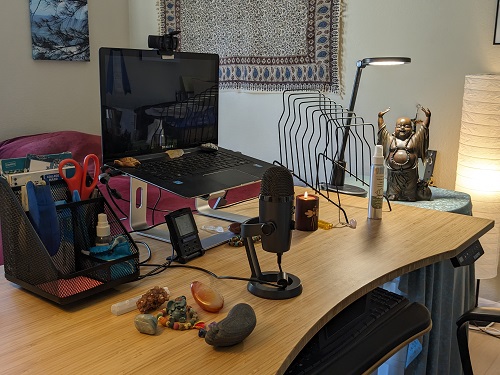
Having objects that have meaning for you in areas that you spend a lot of time in (such as the bedroom, your desk, the kitchen counters, your home gym area etc.) can help you connect to a deeper sense of relating to whatever you are doing. For example, I have rocks, crystals and other objects on and around my computer to help ground me and be a clearer channel during sessions and when I write. It also helps me remember the bigger picture when I’m doing tasks I might otherwise dislike (like taxes, paying bills, doing marketing etc.). Personalize this invitation in a way that makes sense to you.

4) Bring your breath and gratitude to what you’re doing

An easy way to bring more presence to whatever you are doing is to take a few deep breaths before starting. I also like saying “Hi” and “thank you” in my head to whatever I’m doing or whoever I’m interacting with (and “thank you, bye”) to mark the start and beginning, and to tap into gratitude. That may be appreciation for myself, or for whatever the activity or interaction is bringing me.

5) Be in the process rather than the outcome

Again, this is both self-explanatory but also counter-cultural. We have been trained to “keep our eye on the prize” and always focus on our plans and goals. And while that might help us with our accomplishments, it often diminishes our enjoyment of our lives and what we do have, since we end up focusing all our energy on what is currently missing. In truth, being process oriented and reaching our goals doesn’t have to be mutually exclusive. In fact, I’ve found that when I’m in the moment-to-moment unfolding of experience, following where the energy is rather than pushing things with my mind, I manifest what I want much more easefully, and sometimes way beyond what my brain thought was possible.

6) Focus on the deeper meaning of the moment

When we are rushing from one thing to the next, it is easy to take things for granted, or see things/people as a distraction. Which can create a general feeling of frustration, dissatisfaction, and—further down the line—regret at not realizing what we had. If we slow down and get out of “ticking things off our list” mode, we can remember to appreciate whatever is in front of us. Paying a bill is an opportunity to be grateful for whatever it is providing us. Going shopping, we can appreciate we have the money for and access to nourishing food. Showering can be a ritual cleaning activity, and so on.

7) Make it simple (and everything can be sacred)

If you like elaborate rituals and have time for them, by all means do that. But most of us get overwhelmed if something feels too difficult, and then we don’t do it. This does not have to be complicated. Do whatever feels accessible, easy, and enhances your enjoyment of life.

Life as Sacred Ritual

Give yourself space

Spread your wingspan
to full capacity

Out, out, out…

till you touch
the immensity
of possibility
when you live
in Infinity

The only limits
are self-generated,
trauma perpetuated

B R E A T H E
your lungs

out, out, out…

beyond distorted prisms,
twisted stories
imprisoning potentiality

E x p a n d
into the
unknown

Elevate drudgery
into art

Make the mundane
a sacred ritual

Reclaim sovereignty
over experience

Let the mystery
dissolve matter
until you float
in the bliss
of beingness

© Jenny Brav



Making the Mundane Sacred *2024-05-20T14:26:08+00:00

Letting Go of Your Old Stories *

Do you have stories about yourself or the world that define your life? Are there certain patterns that keep on repeating throughout your life?


When you hold onto a script that doesn’t serve you, you leave no space to write a new one that does.” – Jennifer Ho-Dougatz


Many of us have old stories or beliefs about ourselves and the world that rule our reactions and how we perceive things. We develop these beliefs in order to make sense of our circumstances, or in response to what others tell us. These beliefs or stories often enable us to overcome, or at least explain, difficult situations.

For example, a client who grew up in a war-torn country developed the belief that the world was a cruel place and that she could only depend on herself. This gave her the strength she needed to leave when she was 17, despite being terrified and alone. Decades later and living in very different conditions, however, this belief led her to fear and try to control the unknown, and was holding her back from thriving. Another client, who grew up in a large family with a mother who was overwrought with meeting the physical needs of her many children and couldn’t tend to their emotional needs, learned that his needs didn’t matter. Decades later, he would lose his sense of self in the face of his family’s demands, and was struggling to find his own identity.

The following are five tips for understanding and letting go of your old stories, so you can make space for new possibilities in your life:

# 1: Track recurrent patterns and internal conflicts
Whenever we experience patterns that keep on repeating themselves – be they in our relationships, work environments, or living situations – there is likely to be an old wound that’s wanting healing.

Start writing down conflicts or difficult situations you are currently dealing with or have in the past. Is there something familiar about this situation? Once you have listed some of your struggles, see if you can identify similar patterns that keep coming up for you. Track those patterns to determine if they occur most often in one type of situation (for example, at work or in your personal relationships) or if they are present across the board.

# 2: Make a list of your beliefs
Now that you’ve started identifying recurrent patterns in your life, I invite you to explore the beliefs about yourself that may be at the root of those patterns. One way to do that is to notice the stories and feelings that come up for you around the situations you listed in # 1. How do you feel? Invisible, like your needs don’t matter? Like others can’t handle you, that people are manipulative, that you are less than others? Next to the list of your patterns, start making a list of the beliefs about yourself and the world that you have identified.

# 3: Trace the beliefs back in time
Now that you have identified your beliefs, track them back in time to when you first started feeling something similar. What was happening at the time for you? How were you learning that your needs didn’t matter, or that the world is cruel, or that you would always be abandoned? They may have developed as a result of one traumatic incident, or of multiple similar incidents over time.

# 4: Acknowledge your story for its intention
We develop our beliefs and coping strategies for good reasons. And oftentimes, our automatic responses and ways of understanding the world were generated at a very young age. Send empathy to your younger self for the circumstances that led them to create the narrative they did at the time. If appropriate, also send acknowledgment to your story for having served you in some way. For example, it pushed you to try to be the best, or stay under the radar, or to put others first. And let your younger self know that your circumstances have changed, and that if you let go of the old story, they will be able to get what they most wanted back then but couldn’t have. For example, love, validation, the ability to be completely themselves.

# 5: Start writing your new narrative
Look at your list of beliefs and patterns. These are the unconscious blueprints with which you are running your life. It’s like a computer that’s still running on a very old operating system. And begin to write the new beliefs and new narrative you would like to have about yourself and the world.

When you feel the old story and feelings comping up again, I invite you to pause. Send your younger self love. Remind yourself that just because the old belief feels true (since you’ve been replaying this track over and over again for a long time) doesn’t mean it is true. And look over your list of new beliefs, picking one or two you want to focus on anchoring. Repeat this new belief to yourself whenever you notice yourself running the old program — until someday, this new belief becomes your new baseline.

Don’t spend your life believing a story about yourself that you didn’t write that’s been fed to you – that simply you’ve accepted, embedded and added to. Let the story go and there beneath is the real you…and your unique gifts, heart and path that await you.
– Rasheed Ogunlaru

Unraveling Old Stories

I unravel the old stories
Reified into my veins as truth.
As I untangle gnarled knots
Of “I can’t” and “not enough,”
Of overwhelm and anxiety,
They stream out
In colorful garlands
Of ease, trust, and adventure,
Paving the way
To new horizons —
Free from the fetters
Of my past.

© Jenny Brav


<


Letting Go of Your Old Stories *2023-12-31T19:11:36+00:00

Step into your Bigness*

“Our deepest fear is not that we are inadequate. Our deepest fear is that we are powerful beyond measure. It is our light, not our darkness, that most frightens us” – Marianne Williamson

In a recent session, a client who has chronic physical pain saw herself unzipping the small, narrow suit she has been trying to fit into since her childhood, and stepping into a big, unlimited self. Her big self (which can also be seen as her essence, or whole self) was free from old patterns of either needing to collapse to be safe, or fight back to try to assert her autonomy. Her body—and in particular her joints and nerves—had so much more space to breathe when it wasn’t trying to fit into others’ ideas of who she needed to be.

Although the degree can vary widely, all of us have been wounded. As a result, we developed beliefs and coping strategies to help us understand and manage those wounds. When our circumstances change, but our beliefs and strategies do not, the latter end up perpetuating the very thing they were designed to fight against. Crises (physical or emotional, internal or external) and feelings of stuckness are usually an indicator that a part of us is ready to grow and evolve, while another (usually younger) part of us is clinging to the old strategies for dear life, terrified of what the consequences might be if we let go. The way forward is for the young self to feel heard, held and acknowledged, while simultaneously realizing that the situation has changed, and that it’s safe to let go.

Here are five tips for accessing your bigness and stepping into your power.

1. Notice your small self

Start tracking what it feels like when you are triggered, reactive, or shut down. How does your body feel? What is your posture like? What are you believing about yourself and the world? Is there a pattern to what triggers you—such as feeling misunderstood, or like you don’t matter? I invite you to keep a journal for a week or more to take note of this.

2. Explore the origins

When we are triggered, we are usually filtering and reacting to the world through wounded child eyes, even though the arguments we use to justify our reactions may tap into our adult faculties of reasoning. When you are feeling reactive or collapsed, ask yourself “what age is associated with this response?”

If nothing comes up, I invite you think about your childhood. If there was an age when you started learning X (whatever belief you identified in #1), what age/ages might it be? It might also be a timeframe more than one age. What were the situations or the people you were learning that from?

3. Send compassion to your small self

Imagine that your adult self is with that young part of you. What would have been helpful to hear back then? For example, “It’s not your fault.” “I’m proud of you.” “You’re not alone anymore, I’m here.” “You did exactly what you needed to do.”

If it feels appropriate, imagine that you are projecting images of your current life to your young self/selves. Let them know that their situation isn’t going to be like that forever, that things are going to change, and that you have resources they didn’t have.

4. Step into your big self

I invite you to close your eyes, and feel back into that feeling of a small self. Imagine that in front of you is your big, wise, essential self. If that’s hard to call up, you can also bring in a powerful energy/being you feel resonance with. For example a tree, a tiger, a mountain, a spiritual teacher or religious figure. Visualize yourself unzipping your small self, and stepping out of it. You can do that as slowly as you need to, over several days or week if necessary. When you are ready, feel yourself merging with your big and wise self and/or with the powerful being you called in. Notice what that feels like in your body. What does the world feel and look like when you look at it through your wise self eyes? Once you feel somewhat comfortable with this big version of you, you may want to bring up a person or a situation that has felt problematic to you. Does looking at it through these eyes shift your perception?

In a recent session, a client of mine merged with mountain energy. When she looked at people who had always been intimidating to her young self through mountain eyes, they seemed much smaller. She could see how they were trapped in their own pain.

5. Creative depiction

I invite you to find a creative way to further anchor this version of you into your body and subconscious. When I say creative, I’m referring to whatever way you have of accessing a deeper part of yourself. You could do this as a guided meditation, or feel yourself stepping into your bigger self as you are hiking, walking, biking, running, swimming, paragliding… You can draw/paint it, write a poem on the theme, or dance the transition from small self to big self. You could do a body sculpture or mime it. A combination is also possible. I wrote a poem entitled “Ode to my small self,” drew a picture of myself shedding the old patterns and fully stepping into my essential self, and have been visualizing it in some of my daily meditation practices. Just in case the universe didn’t get it the first time.

I wish you luck on your journey, and feel free to leave a comment on how that went for you.

The following is a guided meditation for stepping into your wise self.


© 2020 Jenny Brav


Step into your Bigness*2023-06-20T11:50:38+00:00

Making Space for Forgiveness *

Do you feel weighed down by the past? Can it be difficult to forgive yourself or others?

“Forgiveness is the fragrance that the violet sheds on the heel that has crushed it” – Mark Twain


In this era of flinging blame and pointing fingers, forgiveness often feels like a scarce commodity. While there is general consensus in the mental health world that forgiving and moving on is beneficial for our well-being, in practice the topic can be a thorny one.  Especially for those who have experienced trauma, abuse or neglect, forgiveness can seem like being asked to excuse what happened and to give the perpetrators a free pass. Or it may feel like one more instance of being asked to take the higher ground. In the case of something that

we did, forgiveness may feel like letting ourselves off the hook.

Anger is an appropriate and important response to trauma or any kind of boundary violation, and being able to access and accept anger is often critical to healing. Conversely, anger at ourselves may be a first step towards owning and changing old patterns that no longer serve us. In the long-term, however, hanging onto resentment often keeps us energetically tied to the event or people we are angry at, and therefore unable to heal or move forward. When directed at ourselves, it may actually perpetuate the very behavior we are wanting to transform.

Whether you are working on forgiving either yourself or others, the following are six tips to help you on your journey:

#1 Accepting your anger

If we leap to forgiveness before connecting to and accepting our anger, we will merely be bypassing the hurt that is needing attention. The first step is therefore to validate the wisdom of the parts that are hanging onto resentment towards yourself and/or others.

To do that, feel into any part of you that is unwilling to forgive. Ask yourself what that part is trying to achieve for you. For example, it wants to protect you, punish someone (or yourself) for what happened, ensure it never happens again, motivate you to change, and so on. Send gratitude to that part for its intention for you. And ask yourself if holding onto the resentment has been effective in achieving the goal it has for you. If not, see if that part might be open to trying a different way.

#2 Accepting what is

Wherever there is a reluctance to forgive, there is usually resistance to accepting reality. Unfortunately, we cannot change the past, and resistance only further entrenches us in what happened since it prevents us from moving on.

Feel into ways that you may be resisting things that cannot be changed. Again, send gratitude to the resistance for trying to protect you. And then ask yourself how it might feel to simply allow things to be as they are, and move forward from there. For more tips on accepting things as they are, see my blog post on the topic.   

“Forgiveness is not an occasional act, it is a constant attitude.” – Martin Luther King

#3 Realizing it’s not personal

If you are working on forgiving someone, it can be freeing to realize that whatever happened wasn’t personal (which doesn’t mean there isn’t a huge personal impact to you). Of course when something tragic happens or your boundaries are violated, it feels very personal. However, it’s not your fault. Other people’s actions are their responsibility. Freeing ourselves from responsibility for others’ behaviors actually creates more space for giving ourselves compassion. And eventually may give us compassion for the other’s pain, if that is appropriate.

If it feels safe and will not be too triggering, I invite you to call up the image of someone who you are having a hard time forgiving. You may want to set your energetic boundaries first as described in the guided meditation at the end of this blog post or do anything else that will help you feel grounded and safe. Give yourself plenty of space to feel and allow for any emotions that come up. And imagine that you are giving back – preferably without anger — anything you might be unintentionally holding of theirs. Their judgment, pain, anger, insecurity, jealousy, power struggles… You can say out loud “this is no longer mine to hold.”

#4 Forgiving yourself

Although it seems that forgiving ourselves means we are likely to repeat the same mistake, when we are angry at ourselves we are actually more likely to repeat the behavior, because there is an internal war going on. Taking full responsibility for our actions usually requires the ability to fully face and accept our own imperfections.  

Whether your anger is towards others or yourself, at least some of it is usually directed at yourself – be it consciously or unconsciously. Notice if there is a way you are blaming yourself.  Feel the impact that the self-blame is having in your body and heart. See if you can send yourself compassion for the pain that you have, instead. Ask yourself what you would need to be able to forgive yourself.

#5 Letting go of inherited pain

Often, when we have been hurt or hurt others, there are old ancestral wounds on both sides needing healing. While that doesn’t exonerate us from responsibility for our own actions, realizing that there are often generations of unresolved baggage wanting to be healed through us can sometimes help put things into perspective. The following is one resource for healing ancestral wounds: http://ancestralmedicine.org/ that has been very helpful to me in my path.

#6 Choosing freedom

Forgiveness only works if it is not an expectation, but a choice. And a choice you make not to be a better person, but because you want to free yourself of the burden of hanging on. Ask yourself, if today were the first day of the rest of yourself, would you want to be weighed down by resentment towards yourself or others? Close your eyes, and imagine in as much detail as you might be feeling and living your life if you chose forgiveness. 


Forgiveness

Is the lightness
In my step
As I shed
The old shackles
Tying me to my pain
And to your transgressions.

I release myself
From your shadow
And my own.

I unravel
The rope
Of suffering
Snaking back
Through centuries
Of inherited wounds.

I see past
My stories
To the mirror image
Of my sorrows
Reflected
In your eyes.

© Jenny Brav


Making Space for Forgiveness *2023-02-07T20:56:44+00:00

Healing Childhood and Family Wounds*

Do you feel like your childhood wounds are still interfering with your life? Does being with and/or thinking about your family trigger strong reactions in you?

“When we’re all living in the space of the inner child, loving, honoring, respecting, and embracing its desires, we are at peace.” Kim Ha Campbell

Most of our core wounds come from our childhood experiences. We might have gotten the message that we were too much, not enough, that parts of us weren’t acceptable and had to be hidden. We may have experienced neglect, abuse or other forms of trauma. The beliefs and coping strategies we developed as a result often stay with us long after our circumstances have changed.

Whether we are still in touch with our family or not (and whether our family members/caretakers are alive or not), the holiday season and certain anniversaries can be triggers for all that old stuff to come to the surface. Similarly, the old patterns often rear their heads when we are on the cusp of big transitions, and one part of us (usually the current, adult self) is ready to change, while another part (usually a very young self) is terrified and thinks change means certain death.

The following are five tips for beginning to heal childhood and family wounds:

1. Identify the wounds

Most of the time, we are not even aware of the old programing that is still running our thoughts and our nervous systems. Something happens, and whatever we are feeling and thinking feels like the truth: we are being dismissed, or victimized. Others really don’t care and can’t be trusted. However, these are just beliefs, the lens through which we are interpreting events. The first step is therefore to identify what the wounding and the beliefs are.

Is there a feeling or thought that is often recurring for you? For example, do you have a story that you are not welcome, or that nobody sees you? Perhaps think of a recent situation that triggered a strong reaction, or a difficult interaction with a family member. What were you believing about yourself or the other in that moment? Examples include: “I don’t matter,” “I’m invisible,” “others’ needs matter more than mine,” “I can either honor myself or please others, but not both,” “showing vulnerability is weak, and others will take advantage of me…” Write down your belief.

2. Feel into the emotions

To go more deeply into the wound, I invite you to notice what emotions come up for you when you are believing the words you wrote down in #1. These might include sadness, frustration, helplessness, rage, fear, confusion and so on.

When you access these emotions, check in with your body and notice the physical sensations there. Does any area get tight, achy or jittery? Does any part of your body (or perhaps even the whole body) feel distant or numb? There is no need to try to fix or change it, we are simply exploring and getting curious about what is there, what is wanting our attention.

3. Trace the belief and feelings back in time

Closing your eyes, imagine that you are following the belief, emotions, and physical sensations back in time, to a time, situation or place when you first or most significantly felt something similar. You might get a memory, or just a felt sense of something. You might also access a time period more than a specific incident. What was happening at the time? How was your young self feeling? What was he/she learning about him/herself and the world? What was s/he deciding to do to cope with the situation?

4. Bring love and healing to your young self

The wounding happened because your young self was needing something he/she didn’t get. Common unmet needs include safety, connection, feeling seen/understood, feeling that our voice matters and so on. The best way to begin healing the wounds and upgrading our coping strategies is to start offering that missing experience to the young self. What were they needing that they didn’t get?

Once you have a felt sense of your young self, imagine that your current self is entering the space with your young self. Let them know you are there to support them. Say something to them that would have been really helpful for them to hear at the time. “It’s not your fault.” “I’m here, I’ve got you.” “You are perfect exactly as you are.” “Their inability to be there for you in the way you need reflects on them, it has nothing to do with your needs.” Or if what your younger self is needing is physical presence more than words, you can feel yourself holding that part of you, giving him/her love.

 5. Start imprinting new possibilities

Give your younger self an energetic hug. Let them know you will keep on checking in on them. Now imagine that you are fast forwarding in time to a time when you have released that belief about yourself and/or the world. You realized that it was just a belief you developed when you were very young as the best way you could make sense of your experiences at the time. It’s not the actual truth.

What new belief would you like to replace the old one with? How are you feeling and living your life with this new programming? Feel and imagine it in as much detail as possible. And if it doesn’t feel accessible yet, keep doing the first four suggestions until it does. When you are ready, visualize yourself dropping this image of you operating on this new belief into your crown, and letting it permeate all the neural pathways that have been conditioned to the old belief. Feel it spreading to all the cells, muscles and tissues in your body. Placing your hands on your heart, imagine you are filling your heart with this new belief. When your heart feels full, feel it radiating back out into the universe.

The following is a guided meditation for healing your younger self based on the above tips:


© 2019 Jenny Brav


Healing Childhood and Family Wounds*2023-07-11T11:41:30+00:00

From Why to Hi *

“Why am I still so afraid of expressing myself? I know I have no reason to be!” a client recently asked in frustration. Although the specifics vary from person to person, exasperation is a common experience when one part of us has outgrown a belief or coping strategy, but another part of us is continuing to hang on for dear life.



Having the insight that our beliefs/emotions/coping strategies don’t match our circumstances can be a helpful first step towards transformation. In and of itself, however, it’s not enough to effect change. And when coupled with impatience and the need to understand, that knowing can actually slow the process down significantly.

In this blog post, we’ll explore how we can shift our “why” into a “hi,” which is much more likely to move us towards lasting change.

Why/What/How Energy

The mind wants to know. That’s its job. And for many of us, we’ve learned that our analytical brain can provide safety and a sense of control in an unpredictable world. However, when we want to know why we’re feeling a certain way (or “how” to change it, or even “what” we’re meant to learn from it), the underlying message we’re sending to that part of us is that there is something wrong with it. Which merely reinforces the shame that usually led to the belief, wound and/or coping strategy in the first place.

Reinforcing Shame

Energetically, shame is one of the stickiest of emotions, and one of the main reasons we may find it difficult to shift out of old patterns. As children, many of us were given the message that we shouldn’t be feeling the way we were, and we certainly shouldn’t be expressing it. Or that some aspect of our being-ness needed to be changed/fixed for us to be accepted and/or safe.

Therefore, anything that resembles judgment (which “why” certainly does) is merely going to reinforce the wounding and the strategies. As cliché as it might seem, compassion is the only energy that will allow our younger parts to feel safe enough to begin to let go.

“Hi” Energy

What if, instead of saying “Why am I feeling fear?” you simply said “Hi fear (or anger, hopelessness, resistance…)”? The hi immediately brings an energy of welcoming. Of allowing things to be as they are. “Hi part of me that’s not ready to change.” “Hi part of me that’s impatient and ready to be done with this.” “Hi overwhelm.”

Saying hello is simple, easy to remember, and the perfect antidote to judgment and “either/or” beliefs. In this space, every part of us can show up at the table, and we can acknowledge each one for what it’s trying to achieve for us (even if the methods can sometimes use some upgrading :>).

Curiosity vs. Analysis

Once we are in that “hi” energy, we can be curious about the origins of our beliefs, emotions, or habits, without bringing judgement to them. While curiosity might seem similar to “why,” the feeling tone of it is actually the opposite. Instead of coming in with preconceived notions of the desired outcome, we’re merely wanting to know more, and are open to wherever the journey takes us. While most of us hate being analyzed, it usually feels good to sense someone’s interest in knowing more about us!

In the case of the client mentioned in my first sentence, our exploration led us to discover that the fear of self-expression actually originated with his maternal grandmother, whose husband was extremely abusive. It was then passed on to his mother, who had to keep the family secret in order to maintain appearances.

While the support of a trained professional might be helpful in the deeper exploration that curiosity can bring us to, “hi” is accessible to all of us, at all times. And you may be surprised by how transformative this seemingly small step can be!

Once we’re comfortable with using the “hi” for ourselves, this can also be a powerful way to change how we hold other people’s behaviors. Rather than greeting our child, partner, coworker, friend, or parent with the unspoken but felt energy of “why [the h***] are you doing XYZ/acting that way??” what if we approached them with that same feeling of allowing and accepting? I invite you to play with your capacity for saying “hi” to whatever arises, and see where it takes you.

Feel free to share the results in the Comments section.

©Jenny Brav


From Why to Hi *2022-02-15T14:55:26+00:00

Emotional hygiene: online resources for uncertain times

We are all being impacted by the covid-19 pandemic in different ways. For most of us, old wounds, beliefs, and/or survival strategies have been activated to some degree. Some of us are going into freeze mode: feeling overwhelmed, and wanting to check out/shut down. Others are going into an aborted flight response (since we can’t actually flee): feeling anxious and hyper-vigilant. Yet others are going into fight mode: resisting what is, or getting angry about how things are being handled. Or we might be cycling through all of them. Whatever our response, we can offer compassion and understanding for what is coming up for us.

While caring for our emotional hygiene can easily go on a back burner in the face of everything else that is happening, feeling grounded is just as important for our immune system as eating the right foods, taking supplements, and hand-washing. The following is a list of some online resources for grounding and dealing with difficult emotions. It is in no way exhaustive and many of the online groups are local (to the Bay Area), but it is a starting place.

Grounding/meditation resources

Working with difficult emotions:

Online community events

For some of us, this might be a good time to pursue creative endeavors we might not normally have time for (alone or as a family), such as writing, painting/drawing, dancing at home…

For those looking for community events:

Yoga/movement:

While it can seem that being quarantined, on lockdown, or “sheltering in place” would mean having to stay inside all the time that is not the case in most places, and I highly recommend being in nature if possible.

I’m not going to list all the online fitness, yoga, and movement resources available (thankfully, there are many). Local dance, fitness, yoga etc. classes are all going online. Many of those can be found on meetup, too.

My favorite online yoga teacher is Yoga With Adriene. She has numerous free videos, and has created a “yoga for uncertain times” playlist: https://www.youtube.com/user/yogawithadriene/playlists. Her rainbow yoga video can be done with the whole family: https://www.youtube.com/watch?v=dF7O6-QabIo, and she has at least one video for kids.

This is an example of a weekly online movement class: https://www.jennevieveybarra.com/online-embodiment.

Qigong is also a wonderful movement practice for grounding, and this is one example of classes that have gone online: https://www.qigonginstitute.org/category/8/classes-and-online-qigong

Other: 

This is a list of informational and other resources, and includes possible online activities (such as museum virtual tours, and “digital safaris”): https://www.hunterleight.com/covid19-resources

Stay safe and healthy. Feel free to share this with others who might find it useful. If you have other suggestions that might fit in this list you can send them to me, and I’ll be periodically updating the resources on my website.  

© Jenny Brav

Emotional hygiene: online resources for uncertain times2020-03-24T00:19:27+00:00

Healing Trust Wounds *

Can it be hard to let down your guard? Do you hate feeling out of control? Can it feel like life is an uphill battle?

“I have come to accept the feeling of not knowing where I am going. And I have trained myself to love it. Because it is only when we are suspended in mid-air with no landing in sight, that we force our wings to unravel and alas begin our flight.”—C. JoyBell C.

The ability to trust is critical to our capacity for manifesting ease and flow in our lives. During a difficult period in my life, each time I ask my higher knowing what I was meant to be learning, I heard: “to trust and surrender.” While it is a work in progress, being able to open to and accept myself, life, and others exactly as we are has loosened the vice-grip of doubt and judgment, and opened up space for curiosity and play.

Without trust it is difficult to take risks, to be resilient during challenging times, to face the unknown. Our natural state (free from trauma and other experiences that disconnect us from our essence) is trusting and open. And yet so many of us learn at some point that being too trusting is naïve and can lead to pain at best, and dire consequences at worst. We decide that to be safe we need to be hyper-vigilant and/or in control. These wounds and resulting coping strategies can impact our ability to trust ourselves, others, and/or the universe.

The following are possible indicators of the different types of trust wounds (the list is not comprehensive):

1. Difficulty trusting others

  • It is hard to put your guard down around others
  • There are few people you trust enough to be completely vulnerable with
  • You have self or other-identified “commitment issues”
  • You try to control others’ behavior in subtle or overt ways
  • You’d rather drive than have someone else drive
  • You are constantly scanning others to know if you are safe with them

2. Difficulty trusting yourself

  • You have low self-esteem
  • You have a hard time making decisions
  • You judge the “rightness” of your decisions based on the outcome rather than the process
  • You struggle with not feeling enough
  • You are envious of others and feel like it’s inherently easier for them than for you
  • You often ruminate over the past and regret past actions/decision

3. Difficulty trusting the universe

  • You have patterns of generalized anxiety and hyper-vigilance
  • You spend a lot of time trying to manage and predict the future
  • You have a belief that if you are too happy something bad is going to happen
  • You need to control your environment to feel safe

Often we have a combination of a few indicators from two or all of these categories. The following are six tips for beginning to make space for trust and surrender.

A) Identify your wound(s)

Look at the above list, and highlight the ones that you feel apply to you. If there are multiple ones, pick 3 that feel like the biggest obstacles to happiness and/or ease in your life.

B) List possible limiting beliefs

Write down what you think your limiting beliefs around trust might be (it might be more obvious for some of the indicators than others). These might include some version of: “I’m not enough,” “trusting others is gullible and naïve,” “I can never get it right,” “Those I trust always betray me,” “The only person I can trust is myself…”

C) Notice your body and emotions

As you look at your list of limiting beliefs, notice what it feels like in your body. Does any area of your body get tense or jittery? Or do you leave your body and/or does it go numb? What emotions come up for you? For example, do the beliefs bring up anger, fear, helplessness, grief…? You might want to write these down as well.

D) Trace the beliefs and emotions back in time

I invite you to close your eyes. If it is part of your practice, you might want to set up ceremonial and/or meditative space. This might involve lighting a candle, putting on relaxing music, going out in nature, or anything that helps you drop in more deeply into yourself.

From here, imagine you are following the physical sensation, belief, and emotions back in time, to a time when you first or most significantly experienced something similar. If the trust wound was in response to a specific event you might access a memory, or if it was linked to repetitive experiences you might find yourself at a certain time period in your life, or see a series of memories.

E) Bring healing to your young self

Whether you have a specific memory or not, imagine that your current self is entering the space with the young you who was learning that it wasn’t safe to trust him/herself, others, or the world. If there are others in this image, be sure to freeze them so your younger self feels safe. Let him/her know you are there as an ally. Say anything that might have been helpful to hear at the time. Doe example: “It’s not your fault.” “Even though it feels personal, this has nothing to do with you, and everything to do with them and their wounds/coping strategies. They were like this long before you were born.” “I love you. You are not alone.” “You are perfect exactly as you are.”

Tell your younger self that it was very smart of them to develop the beliefs and coping strategies that they did so they could make sense of what was happening to them.

F)  Update the beliefs

Once it seems that your younger self is feeling seen, heard and safe, tell them that if/when they decide they want to let go of the belief, they can let you know and you can help them release them. It is critical that the decision to release the limiting belief come from the young self and not your current self, otherwise you are just one more adult who’s needing something for them rather than just being there for them. If it feels appropriate, you can perhaps show your young self that what they wanted more than anything else at the time was to trust and be open, but because that wasn’t possible they developed the belief they did. Back then, it served a purpose, but at this point, the only thing between you and freedom is the belief.

When/if they are ready (and if not, keep doing step E as long as is necessary), imagine you are releasing the belief together. You might write it down on a piece of paper, and then tear it up.

Next, write down what new belief (or intention) you want to replace the old one with. For example “Everything is always as it needs to be.” “I can trust that I have everything I need.” “I am learning to trust my inner knowing.” “I am healing my mistrust of others and the universe.” “I am enough exactly as I am.” You might see yourself dropping this new belief into the top of your head and feeling it spreading through the neural pathways that were impacted by the old belief.

Envision yourself stepping into your life with this new belief about yourself and the world. Imagine this in as much detail as possible, in different areas of your life such as work, relationships, creative endeavors, health and so on. Keep doing step F (especially dropping the new belief into your mind and body) every day until it feels more and more true.

Trust
Is allowing
Our heart to rule
Our actions.

Trust is letting go
Of the fantasy
Of how things
Should be;
It’s the deep knowing
That things are exactly
As they’re meant to be.

There is no other way.

Trust
Is the jellyfish dance
Of opening and contracting,
Of testing the boundaries
Being self and other,
Of honoring
Our true yes and no.


© 2019 Jenny Brav


Healing Trust Wounds *2022-02-03T14:40:07+00:00

Accepting Things as They Are (Not How You Want Them to be) *

Do you find yourself arguing or negotiating with reality? Do you spend a considerable amount of mental energy ruminating about the past, or trying to control the future?

“The secret of health for both mind and body is not to mourn for the past, worry about the future, or anticipate troubles, but to live in the present moment wisely and earnestly.” ~ Buddha.

While the Buddha’s invitation to be in the now and to accept things as they are has permeated mainstream Western culture as a desirable way to live, our societal conditioning is more than ever to live in our thoughts, and to see the present purely as a means to a future goal or as the outcome of past actions and decisions. Many of us are so busy leapfrogging over the present to get to the next thing we barely notice it. So what does it mean to live in the present, and accept things as they are?

Over the holidays, I had the chance to sit with that question. Literally. For hours on end. I participated in my first 10-day silent Vipassana (in the Goenka tradition). Although a meditation retreat sounds restful and peaceful, we were up at 4am and in bed by 9:30am every day, with 10+ hours of meditation a day. We were not allowed to read, write, eat a meal after noon (other than fruit, for the new students), exercise, meditate outside, or communicate with each other in any way. The retreat provided me with many opportunities to sit with my resistance patterns. The first few days, I watched my mind as it chewed over things that were not going to change and grumbled at my decision to spend my only time off sleep deprived and in pain. While the thoughts and the pain did not entirely disappear, as the teachings progressed and I went deeper into myself, my relationship to them began to shift.

The following is a distillation of some of the main lessons I received from the experience and how they might apply to your life.

Being with things as they are

The cultivation of equanimity – the ability to remain internally grounded regardless of external circumstances – is fundamental to Buddhism and to Vipassana meditation. On day 4 of the retreat, we were asked to practice “strong determination” and to commit to not moving during the three formal hour-long sits of the day. In the recordings of Goenka that were played each night, he invited us over and over to notice “things how they are, not how you want to be.” I realized how much concentration it required of me to be present in each moment, and how much faster time went by when I let my mind wander off on its thought trains.

I invite you to start feeling into your own resistance patterns. Are there areas of your life you are unhappy about? Is it difficult to accept certain things about yourself, other people, or your circumstances? While we think that arguing with reality is the only way to bring about change, in truth it only serves to multiply our misery, and often keeps us stuck in the very situations we are wanting to shift. Try tracking for an entire day all the times you resist or check out from the present moment in a day. And ask yourself what it might be like to just allow that things are as they are, at least for now.

“Resistance keeps you stuck. Surrender immediately opens you to the greater intelligence that is vaster than the human mind (…). So through surrender often you find circumstances changing” – Eckhart Tolle

Not good or bad

Our human brains are trained to judge and classify, and we are continuously sorting things through a good/bad lens, which has us continuously running after the good and attempting to avoid the bad. In order to reach greater equanimity, the invitation is to begin to retrain our minds towards neutrality and acceptance.

Begin to notice your patterns of aversion and craving. What kinds of things do you avoid? For example, it may be judgment, uncertainty, feelings of failure, crowded places, being alone. What kinds of avoidance or distraction strategies have you developed in order to try and avert that? And conversely, what do you cling to and crave? Often they may be the flip side of what you are wanting to avoid.

“Nothing is wrong—whatever is happening is just “real life.”  – Tara Brach

This too shall pass

Another importance concept Buddhism is that of impermanence. While we are in the middle of a difficult situation, it often feels as though it is never going to change. As I sat with excruciating pain shooting through my shoulder, it was all I could do not to massage it or change my position. But as I focused my attention inside the pain, I could feel subtle pulsing all around it, until the stabbing intensity started to dissolve. Goenka reminded us over and over again that the pleasant sensations were also impermanent, and that if we started chasing after them we would only be causing misery for ourselves.

Next time you are unhappy with your situation or experiencing difficult emotions, remind yourself that “this too shall pass,” and that the less resistance and story there is around whatever is arising, the faster it will pass. And when things are going well, remind yourself that this too shall pass. While this thought can create pain and fear, it can creating space for greater appreciation of the current moment.

Dis-identifying with your thoughts

Perhaps one of the trickiest ideas in Buddhism to fully grasp is that of no self. Goenka pointed out that much of the suffering we create for ourselves is because of our identification with our thoughts and with our sense of self. If the same thing were happening to someone else, we would not have the same reaction. Once I was able to sit with equanimity (for the most part) with my pain, defensive thoughts got hold of my psyche. While they felt much more personal than the physical pain, I was able to see how those thoughts were not me, and were just pulling me out of the present moment. And when I got to the place where my body was just molten liquid dissolving into all the other atoms around me, I caught glimpses of the inter-connectedness of all things.

The mantra I repeated many times to myself during and after the retreat which summarized the teachings was: “not good, not bad, not mine, not personal, not permanent.” Next time you notice yourself identifying with your thoughts or your pain, I invite you to repeat the mantra, or any other that resonates with you. And remember, this too shall pass.

© Jenny Brav


<


Accepting Things as They Are (Not How You Want Them to be) *2024-03-12T12:21:43+00:00

The Frequency of Fear *

Are there certain areas of your life where fear is holding you back? Are there other areas where fear is your motivator for action? Would you like to learn to navigate these with more ease and grace?

“Fear is a natural reaction to moving closer to the truth” – Pema Chödrön

tree-77271_1280

With the events happening worldwide and nationally over the past few months—not to mention the upcoming presidential elections-the vibration of fear is more tangible than ever. It is therefore a critical time to gain a deeper understanding of the impact fear can have for us as individuals, and as a global community.

The evolution of fear

From an evolutionary perspective, there are several reasons why fear is so potent.

1)     Fear can be a life saver—mobilizing our internal resources to escape imminent danger and activating our fight-or-flight response. It has been shown that a certain amount of pressure can enhance performance (see the Yerkes-Dodson law) up to a point. Past that threshold, it can lead to overwhelm and the freeze response.
2)     Fear is central to socialization. In both tribal and more complex societies, fear of the other can create a powerful sense of bonding/belonging. In addition, fear of punishment or public shaming are both strong incentives for following the rules. Historically, being outcast from our tribe greatly diminished chances of survival, and so fear of being shunned is deeply imbedded in our DNA.

Fear and coping strategies

On the other hand, fear can become debilitating when linked to a feeling of powerlessness arising from a conditioned response based on: a) past experiences or b) worries about the unknown future. In that case, fear can activate our freeze response, so we feel paralyzed and unable to move forward. The more frequently we experience fear (especially when it isn’t a response to something that is presently occurring), the less effectively we will be able to mobilize its resources when needed. Fear is so pervasive in part because the freeze response can be easily manipulated to gain power over other people, at least in the short term. Indeed, the frequency of fear is often used by governments, parents, bullies, and marketing strategies as ways to achieve their goals.

As such, many of the beliefs we acquire as children are based on fears that arise from our early experiences. Fear of being abandoned, of getting punished, of losing love, of not being good enough, of being rejected, of failure, and so on. We then develop coping strategies to manage those fears. These may include giving away our power to others the moment we feel afraid, or building a defensive fortress around our fear. Anger, shame, and sadness are all emotions that are closely linked to fear.

 What is your motivation?

“There are two basic motivating forces: fear and love. When we are afraid, we pull back from life. When we are in love, we open to all that life has to offer with passion, excitement, and acceptance.” – John Lennon 


Two main energetic frequencies guide our actions: that of love, and that of fear. As we grow, we need to learn to dis-identify from our fear—so we can experience it as an emotion that runs through us, rather than one that runs us. In our culture, we often operate on the fear-based assumption that the end justifies the means. However, when we look at cause and effect, what we do isn’t nearly as important as how we do it. The identical action can have a very difficult outcome based on how we hold it.

For example, take the resolution to start exercising. On the one hand, the decision might be motivated from the fear of not being enough (not thin enough, not buff enough and so on). As such, we may exercise compulsively to the point of pushing past our body’s limit and cause potential damage. Or the decision might come from a deep respect for our body and health, in which case we are much more likely to honor our limits and achieve our goals. Same action, different outcome.

The next time you make a decision or take action, pause and see how you feel in your body. The energy of fear is linked to contraction and holding, while that of love is associated with expansion and lightness. Ask yourself: “Am I doing this out of fear or out of love?” Play with what it feels like if you shift from one vibration to the other.

Loving your fear.

Being afraid of our fear only serves to further disempower us. When held with love, however, the energy of fear will dissolve. While it might be counter-intuitive, understanding and making space for our fear can be its greatest antidote.

When you feel yourself tighten in fear, I invite you to pause. Breathe. Send acceptance to your fear. If you wish, you can imagine you are holding a wounded and scared animal—with great tenderness and compassion. Allow your own presence and love to start melting the fear. And you may feel the scared younger part inside of you start to relax and soften.

“A further sign of health is that we don’t become undone by fear (…), but we take it as a message that it’s time to stop struggling and look directly at what’s threatening us.” – Pema Chödrön 
© Jenny Brav


The Frequency of Fear *2022-02-03T14:43:04+00:00
Go to Top