Making the Mundane Sacred *

“There is no mundane dimension really, if you have the eyes to see it, it is all transcendental.” – Terence McKenna

One of the invitations I have been receiving in the past months is to make the mundane sacred. By slowing down, and bringing both presence and reverence to each moment, we not only elevate our experience of life but also our own vibrational state. The current cultural norm of toxic productivity has us rushing from one thing to the next with our eye trained on the future while we frantically tick boxes off our list. This leads to: stress, burnout, emotional and physical tension, disconnection, depression and/or frustration and dissatisfaction.

On the other hand, when we really take the time and live each task or experience to its fullest, we are able to experience much more ease and joy in our relationships and our creative/professional endeavors. And we then naturally start sloughing off anything extraneous to our well-being and contentment.

Here are seven simple tips for making the mundane sacred (with a bonus poem at the end)

1) Slow down

While this is self-explanatory, most of us are conditioned to speed up and get really busy during the big, transitional times. However, the more we breathe, take breaks, spend time in replenishing activities (whether that be in nature, meditating, taking a bath/shower, creating art, gardening, working out, connecting with loved one and so on) the better we’ll be able to navigate things with ease.

2) Declutter/tidy your space

It is difficult to slow down and touch into gratitude/reverence when the space we’re in is cluttered. And our internal and external state often impact each other in either a positive or negative feedback loop. The invitation here is to start with what you are doing/where you are in the moment. If you are about to cook, make sure the kitchen counters are clear. Before you work, clear off your desk (more about that below). Planning a big spring cleaning/decluttering (although it may organically turn into that) is likely to overwhelm you and make you want to put it off, or clean from a rushed and contracted place. So start small.

3) Have ritual/grounding objects in your work/living space

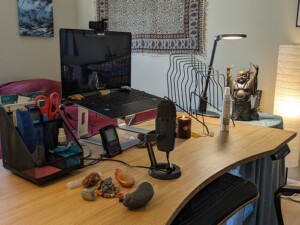
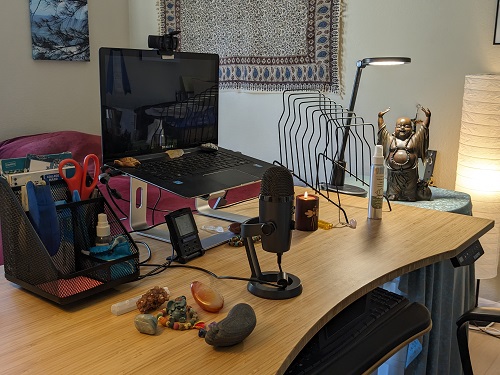
Having objects that have meaning for you in areas that you spend a lot of time in (such as the bedroom, your desk, the kitchen counters, your home gym area etc.) can help you connect to a deeper sense of relating to whatever you are doing. For example, I have rocks, crystals and other objects on and around my computer to help ground me and be a clearer channel during sessions and when I write. It also helps me remember the bigger picture when I’m doing tasks I might otherwise dislike (like taxes, paying bills, doing marketing etc.). Personalize this invitation in a way that makes sense to you.

4) Bring your breath and gratitude to what you’re doing

An easy way to bring more presence to whatever you are doing is to take a few deep breaths before starting. I also like saying “Hi” and “thank you” in my head to whatever I’m doing or whoever I’m interacting with (and “thank you, bye”) to mark the start and beginning, and to tap into gratitude. That may be appreciation for myself, or for whatever the activity or interaction is bringing me.

5) Be in the process rather than the outcome

Again, this is both self-explanatory but also counter-cultural. We have been trained to “keep our eye on the prize” and always focus on our plans and goals. And while that might help us with our accomplishments, it often diminishes our enjoyment of our lives and what we do have, since we end up focusing all our energy on what is currently missing. In truth, being process oriented and reaching our goals doesn’t have to be mutually exclusive. In fact, I’ve found that when I’m in the moment-to-moment unfolding of experience, following where the energy is rather than pushing things with my mind, I manifest what I want much more easefully, and sometimes way beyond what my brain thought was possible.

6) Focus on the deeper meaning of the moment

When we are rushing from one thing to the next, it is easy to take things for granted, or see things/people as a distraction. Which can create a general feeling of frustration, dissatisfaction, and—further down the line—regret at not realizing what we had. If we slow down and get out of “ticking things off our list” mode, we can remember to appreciate whatever is in front of us. Paying a bill is an opportunity to be grateful for whatever it is providing us. Going shopping, we can appreciate we have the money for and access to nourishing food. Showering can be a ritual cleaning activity, and so on.

7) Make it simple (and everything can be sacred)

If you like elaborate rituals and have time for them, by all means do that. But most of us get overwhelmed if something feels too difficult, and then we don’t do it. This does not have to be complicated. Do whatever feels accessible, easy, and enhances your enjoyment of life.

Life as Sacred Ritual

Give yourself space

Spread your wingspan
to full capacity

Out, out, out…

till you touch
the immensity
of possibility
when you live
in Infinity

The only limits
are self-generated,
trauma perpetuated

B R E A T H E
your lungs

out, out, out…

beyond distorted prisms,
twisted stories
imprisoning potentiality

E x p a n d
into the
unknown

Elevate drudgery
into art

Make the mundane
a sacred ritual

Reclaim sovereignty
over experience

Let the mystery
dissolve matter
until you float
in the bliss
of beingness

© Jenny Brav



Making the Mundane Sacred *2024-05-20T14:26:08+00:00

Turning Down the Noise *

Do you feel like there’s never enough time for you? Would you like more space to connect inward?

“Disconnect from everything long enough to see if it feeds your soul or if it’s a distraction. What’s deeply connected will always remain.” – Maryam Hasnaa

When we are caught up in the external noise of life (family obligations, work, distractive habits etc.), that generally means we are out of attunement with ourselves. This may be expressed as anxiety, fatigue, lack of self-care, irritation or depression—to name a few. In order to come back into harmony with ourselves, it’s necessary to turn down the outside noise. The following are a few suggestions for how to do that.

1) Technology detox
One of the most common forms of distractions these days is technology. Reaching for our phones is such an easy way to pass time and avoid feeling. A few months into the pandemic, I realized that my body and nervous system were impacted by the sudden shift to being online so many hours a day (for work, entertainment, socializing, exercising…). I started implementing a monthly internet-free weekend, which has been so helpful for resetting my nervous system. The last weekend of the month, I turn off my wi-fi and phone Friday evening, and turn it back on Monday morning (checking my phone once on Saturday and Sunday morning to make sure there are no emergencies). I do longer than usual meditations, journal and connect to my inner guidance, spend more time in nature, have quality time with my cat, write, and so on.

Some of the benefits are: deeper connection to self and to my intuition; feeling more present and focused; getting better sleep; slowing down; getting perspective on my life. While I know not everyone has the luxury of being able to do exactly what I described, there may be a way to adapt some part of it to meet your needs.

2) Minimizing Numbing/Distractive habits
In addition to technology, there are many habits that disconnect us from ourselves. This includes any addictive behavior (alcohol/drug consumption, food, shopping, gambling, sex/porn, compulsive thoughts and so on). While these behaviors are symptoms that something is needing loving attention, finding ways to minimize the behaviors can be helpful to make space to tune in. One of my clients has found the “Days Since” app helpful to track habits she’s wanting to do less of.

Conversely, it may be helpful to tune in (#3), give yourself compassion (#4), and start with nourishing habits (#5) before trying this one. Sometimes the distractive habits shift on their own when we are implementing the nourishing ones. Feel free to experiment and/or trust your intuition of what works for you.

3) Tuning in
I invite you to spend a little time every day (ideally) or week (depending on your time), tuning in with yourself. That can be through dance, spending time in nature, sitting in silence, journaling, painting, stretching… anything that helps you connect inward. This is best if the focus is on the process and not the outcome. In other words, you’re not trying to paint or write something “pretty,” or stretching to meet a fitness goal. While that is fine, it’s rarely conducive to a true tuning. Listen for any emotions or part that are feeling vulnerable and wanting loving attention (such as grief, fear, insecurity, anger, and so on). This could also be neglected parts such as your creativity and inner knowing.

4) Loving presence
Once you have connected with some part of you wanting loving attention, I invite you to spend some time bringing presence to it. That might be through putting your hands on your body (for example on your heart and/or belly). Doing a loving-kindness meditation. Saying affirmations. Breathing or humming. Whatever feels natural and good. Kristen Neff and Tara Brach are two spiritual teachers with many resources for self-compassion. EFT for self-acceptance can be helpful, as well.

5) Making Time for Nourishing Habits
Make a list of habits that you know are nourishing for you. You can either do this concurrently or once the parts are (hopefully) feeling more seen and heard. This can include any of the ways you used to tune in. And commit to doing one that feels manageable once a day for a minimum of 3-5 minutes. It doesn’t need to be anything big. I’ve found that 5-10 minutes of silence, stretching, and self-massage to start the day and/or close the day can have a profound effect on my clients’ feelings of well-being.

The Space in Between

The space in between
is where it all begins

The gap between words
The silence within speech
The pause from one foot to the other
The stillness within the inner storm
The breath spreading out the time
between thoughts

This is the ground of our being
where solidity dissolves
into infinite              space

This noise we call life
merely veils the two-winged path
of wisdom and compassion
that gives flight to the heart


© Jenny Brav

Turning Down the Noise *2023-03-23T10:47:32+00:00

Embodiment Ritual *

Do you have a difficult relationship with your body? Do you live more in your head than your body? Do you often check out or disassociate? Are you struggling with a chronic illness or pain? If so, an embodiment ritual might help bring your spirit, mind and body back in alignment.

“Enlightenment needs embodiment. Wide-open insight needs deep-rooted instinct. As above, so below” –Kris Franken

From the get go, 2022 was a difficult year for my body. On January 9th, a car ran over the back of my heal, and the wound got infected. I was diagnosed with a connective tissue disorder (h-EDS) in fall of 2021, and tests that I did for that revealed I had was suffering from mold toxicity. This led to months of detoxing, more testing, and negotiating with my landlord (and eventually getting the mold remediated in the fall). I fell and dislocated my shoulder (which I’m prone to, but hadn’t happened in 13 years). A moderately bad case of covid in the summer exhausted me and weakened my lungs…

Embodiment and reconciling my spirit (which would be happy floating as light) and body has been a long-term intention of mine, and was one of the reasons I moved to the Bay Area in 2010 to open a holistic healing practice. With everything happening, however, I found myself resisting being in my body, slipping into old distractive habits. For my birthday in December, I decided to create an embodiment ritual, which I did at Muir beach in Marin, CA. In the rest of the blog post, I’ll be describing what I did/said, and ways you might be able to adapt this to your needs. In terms of location, the ritual can be done anywhere, as long as it’s a place you feel ease in, and there aren’t distractions. If indoors, setting up the space in a way that feels special to you (that can be with music, candles, at an altar, etc.) may be supportive.

Pre-ritual clearing of grief or fear.

If there’s pain, grief or fear when you think about embodiment (or being more in your body), then this might be a helpful precursor to doing the ritual. You can write down or name out loud what you are afraid of or grieving, and then give it to something outside of yourself. This can be a guide, an element, God/Goddess, your higher/wise self, the universe…

Mine was grief at what I’d been through that year and how it had changed the intentions I’d originally had for it:

I give my grief to the ocean, the sun, the wind and the sand.

To the ocean: may you take me to the depths of my sorrows, cleanse me of the old stories and contracts, and bring me back to the surface, for the

Sun to warm my heart, dry my tears, return me to the brightness of my own spirit,

For the wind to fluff out my aura and my wings, and remind me I was born to fly

For the sand to show me support that is both soft and firm, yielding and loving

For this part, you can also do my “Tapping on blocks to Embodiment” video (see below).

Embodiment Ritual

This is intended as a reconciliation practice between two or more parts that feel split and/or at odds. That may be your mind and body, your spirit and your body (as in my case), your heart and mind. It may also be a combination of all three. I find it helpful to use objects that symbolize both. I found a shell for my spirit, a jagged and unique rock for my body, and then another rock that had aspects of both for what I wanted to birth from the union. You can also write words, find images, make a drawing, dance or sing each one, or whatever your natural expression is.

  1. Gratitude

Here, I took the opportunity to express my gratitude to each part. You can also have the two parts express gratitude to each other. For me, that was blended into their apology.

For my spirit:

I love your ability to fly. How brightly you shine. Your fairy nature. The compassionate heart that wings your flight. Your connection to source. The way you help others find their light. Your eternal optimism.

For my body:

I love your sensitivity and attunement to the world around you. I love your patience and forgiveness when I push you too hard. I love how much you try. Everything you do for me despite the lack of connective tissue support. You are a wonderful companion for me, a beautiful reflection of the spirit you’re a temporary refuge for.

  1. Repair

This is an opportunity for you to do any repair that might feel helpful with either or both parts. And, if it feels relevant, for them with each other. Again, I’ve included my words for inspiration, but please adapt it to what feels appropriate for you. Although I’m an amalgam of my body and spirit, for me there was a difference between what I wanted to say to each, and what they had to say to each other, but that might not be the case for you.

Me to my spirit:

I’m sorry if I’ve turned away from you in my pain, if I’ve stopped trusting you or believing in you as much. For the times I’ve checked out and abandoned you.

Me to my body:

I’m sorry for abandoning you when you needed me the most. For not prioritizing taking care of you. For taking you for granted and neglecting you.

Spirit to my body:

I’m sorry for undervaluing you. Resenting you. Thinking you weigh me down. Holding past traumas against you. For forgetting what a gift it is to be in a body. That embodiment was my choice because how else will I hear the ocean, feel the sun, dance, know the joy of touch, taste delicious food…

Body to spirit:

I’m sorry I forget I am not all there is. That I get so caught up in the toil and pain of being a body that I stop believing in you. That I don’t turn to you for healing.

  1. Vows

Here, each part is expressing what they are vowing moving forward. I expressed these as one would in a sacred ceremony between two people who love each other might, but again, you can do this in whatever way feels aligned for you.

Spirit to my body:

I vow to honor, love, cherish and respect you as my chosen companion.

Body to my spirit:

I vow to remember you are my eternal companion. To let you carry me through the burdens of this life. To keep releasing the traumas—both mine and inherited.

My vow to both:

I vow to do my best to stay present in the pain. To honor and make space/find support for my grief. To continue tapping into spirit and source to lift us up as often as possible. To cherish and nurture my body, to love it unconditionally rather than trying to fix/make it better. In sickness, in health, in joy, in sorrow.

  1. Naming what you want to bring in

This part is an opportunity for you to name what you want to birth for yourself through this union/reconciliation between the two or more parts.

From this union, I’m birthing balance. Joy. Trust. Ease. Slowness. Stretching. Embodied wisdom. Limitlessness. Being a beautiful, graceful bridge between worlds. To thrive in co-empowered relationship.

© Jenny Brav


Embodiment Ritual *2023-02-23T10:49:25+00:00
Go to Top