
Navigating Transition *

Are you in a time of change? Do you feel overwhelmed and out of control?

“hold still. stay there. tease back the layers. you are in the space between your comfort zone and infinity. you want to hide. not be seen. not be open. not be vulnerable. but you have to.”

Jeanette LeBlanc

This is a time of great transition for many people. Even when the change is something we’ve worked hard to achieve, it can still trigger old fears and coping strategies. And if the transition is an unwelcome one, it can definitely turn our world upside down.

As children, many of us experienced change as uncomfortable, disempowering, and at times, threatening to our survival. As such, we often developed coping strategies of control and hyper vigilance to try to feel safe. Big life changes can trigger fear of the unknown and anxiety. It may also be challenging to make smaller transitions from work to the weekend, from wakefulness to sleep, and so on.


The following are 6 tips for navigating transition so you can feel grounded and light in moving forward:

1. Notice your response

I invite you to get really curious about your reaction to this period of change. Notice any areas of your body that are calling for attention. What emotions are arising? What thoughts are coming up for you about yourself or the world? You might want to jot down what you are observing in a journal.

2. Identify your beliefs

As you begin to notice your own response, start feeling into a belief about yourself or the World that might be underlying your response. For example, “I’m not good enough,” “I have to control things to be safe,” “change is terrifying.” Is this a familiar belief and feeling? If you wish, you might trace this feeling back to an earlier time, perhaps in childhood, when you felt something similar. What was going on? What led you to develop the belief you just identified?

3. Give yourself empathy

When we are struggling, we often add insult to injury by berating ourselves and resisting our own reaction – i.e. “what is wrong with me?!” While this usually comes from a desire to shift our response, our self-criticism usually only serves to reinforce the parts that are afraid or resistant. You might choose to play with naming and accepting your feelings. I like saying hello to whatever is coming up.

For example: “Hi fear. Hi anxiety. I know you are there. I know you HATE change. I get it. I know that change was often super scary when I was a young. It’s OK to be scared.”

4. Find the ground within

When faced with an uncertain situation, many of us have learned to try to control, manage and predict external conditions to feel safe. That will only lead our minds to spin out of control. The pathway back to safety is through the body and returning to the current moment. Feel your breath. Notice sounds outside. I also encourage finding a short practice you can do every day that helps you feel grounded. A few that I like are: tapping all over my body from top to bottom; shaking for a minute or two; sending my breath down my spine, legs, and all the way to my toes; touching a tree and discharging any anxiety I might have.

5. Invite in new beliefs

Look back at your identified belief about yourself or the world. Now that you have acknowledged your feelings and started finding ways to ground internally, imagine what new beliefs you might replace the old beliefs with. For example “this can be easy.” “I’m creating my own reality, and I’m choosing for this to be fun.” “I am enough.” “My worth is innate and not dependent on my performance.”

6. Do a ritual to mark the transition

I’m a big proponent of rituals to mark the end of one era and the beginning of another (see my blog posts on closing rituals and new beginnings). These practices allow us to take a step back and reflect on what we are leaving behind and what is opening up for ourselves, rather than feeling like we are in the middle of the spin cycle of life.

Here is a brief outline of a ritual you can do either as a meditation, a nature walk outside, or a ritual at home (perhaps lighting a candle, or setting the space in any way that feels good to you). You can also do this as a reflective exercise with your journal:

  • Feel into what is coming to a close for you. What were the lessons you learned? What are you grateful for? What are you wanting to leave behind as you move forward?
  • Feel into the time that is to come. What is shifting for you? What is the theme of this era? What do you want to call in for yourself (this might be qualities, support, or something specific you want to manifest)?
  • What is a question you are sitting with as you enter this new era? For example: How do I let go of what no longer serves me? How can I bring in more ease and joy? You might imagine you are dropping the question into the top of your head and letting it seep into your body. For the next week, pay attention to your dreams, things people say to you, and any messages from the natural World.

May you find peace and ease in this time of change.

Change is the time of the chrysalis –
The soupy mess
Between the caterpillar
And the butterfly.
It is the space from
A and B
We so often try to skip over
In our impatience to arrive.
We forget that there is no future, no there  —
Only the building blocks
Of each present moment
Bleeding into the next.
If I am not here,
Now,
Then I will never arrive.
Because when I land
Into the future
I fret about now,
I will have already jumped
Onto the next worry train,
Having missed the beauty
Of the scenery
Along the way.

© Jenny Brav



Navigating Transition *2024-03-26T10:30:20+00:00

Calming Anxiety & Overwhelm *

Do you find your mind spinning out into worry and anxious thoughts? Is your nervous system jumpy and reactive?

“Anxiety’s like a rocking chair. It gives you something to do, but it doesn’t get you very far.” –  Jodi Picoult,

When I run after what I think I want, my days are a furnace of stress and anxiety; if I sit in my own place of patience, what I need flows to me, and without pain.” – Rumi 

As a highly sensitive and intuitive child, I was prone to worry and overwhelm. The sudden deaths of close family members – starting with my father when I was 8 – intensified my sense of powerlessness in an unpredictable world. When I started my healing journey years later, I learned to view my anxiety as an indicator that some young part of me was feeling unsafe and needing attention. I also discovered ways to ground and find safety in my breath and my body, rather than seeking it in my mind and/or in the outside world.

In my experience, anxiety is often developed as a coping strategy for managing feelings of helplessness in an environment that feels unpredictable and out of control. From an evolutionary perspective, the fight-flight activation of our nervous system was intended to enable us to respond to specific threats and dangers, ending once we returned to safety. Generalized and non-specific apprehension, on the other hand, often leads to sustained states of hyperarousal of the nervous system, which has been linked to concerns such as insomnia, hypertension, certain heart conditions and so on.

The following are five tips for helping calm anxiety:

     1.  Identify and track your triggers

Start noticing if there is a pattern to your anxiety. Are there certain types of situations where your anxiety is heightened? For example, public speaking, having unstructured time, facing the unknown, being alone… I recommend keeping an anxiety journal for at least a week. Notice what thoughts arise when you feel anxious? What is your perspective on yourself and the world? What physical sensations are linked to your anxiety – i.e. sweaty palms, a racing heart, tightness in your stomach?

     2.  Send empathy to your anxiety

Although it may seem like your anxiety is just there to poison your life, it is actually a coping strategy intended to protect you from something. Now that you have starting tracking your anxiety patterns, I invite you to ask your anxiety what it is trying to achieve for you. For example, is it trying to give you a sense of control, predict all the worst case scenarios so you won’t be caught unawares, or avoid disappointment? If it feels accessible, send gratitude to your anxiety for working so hard to keep you safe and protected.  You may feel resistance to appreciating your anxiety because it is causing you so much misery. However, when the pattern’s intention is recognized and appreciated, it is easier to let go of old belief and start bringing in new coping strategies that are more adapted to your current self.

     3.  Connect to your younger self

Now that you have a sense of what your anxiety is trying to achieve for you, ask yourself “if there was an age when I first learned that I needed to _______

[for example, ‘hide my feelings to belong’], what age would that be?” Notice if a memory or an age comes up. What was happening at the time? Imagine that you are there with your younger self, letting them know they are not alone. Send them empathy/understanding for whatever they were going through at the time. And let them know that they are safe now, and that they are OK exactly as they are. If no age/memory comes up, you can just continue to give gratitude and appreciation to the pattern of anxiety.

     4.  Get into your body

The body is the seat of our emotions and needs, and is also where emotional and/or physical boundary violations occur. Anxiety patterns often arise as a response to feeling unsafe in the body. We learn that it feels safer to numb out, escape, or hide out in our minds.  When things feel out of control, our thoughts start spinning, trying to fix and figure things out. However, trying to find safety and grounding through our minds is a bit like a tree trying to ground through its branches and leaves, instead of its trunk and roots. That is not the function of the mind. Grounding and a true sense of safety can only happen when we are fully connected to our bodies.

Next time you feel the anxious thoughts arise, I invite you to pause and breathe. Connect to your body. This can take many different forms: stretching, going for a walk, meditating, being in nature, dancing, doing yoga, working out, and so on. Whatever you do, the invitation is to keep bringing your attention back to your body and the present moment.

     5.  Confront your thoughts

If the thoughts are still spinning or it is hard to connect to your body, sometimes confronting the thoughts themselves can be helpful. This is a way of creating some distance from our thoughts. Byron Katie has outlined four questions that can help us challenge and transform the power negative thoughts can have on us: “Is it true?” “Is it really true?” “How do you feel when you believe the thought?” “Who would you be without the thought?” Next time you feel yourself spinning on a negative thought train, see if you can hit the pause button and choose to get off it. May you experience greater calm and serenity.

Anxiety is the jittery feeling in the pit of my stomach.
It is the metallic taste of unease in my mouth, and the skittish beat of my heart.
Anxiety is the looping thought train that worries my mind in the wee hours of the morning.
It is my younger self letting me know she needs reassurance and love.
Anxiety is my reminder to slow down
Breathe
And return to the present moment

© Jenny Brav


Calming Anxiety & Overwhelm *2024-06-11T13:03:00+00:00

The Frequency of Fear *

Are there certain areas of your life where fear is holding you back? Are there other areas where fear is your motivator for action? Would you like to learn to navigate these with more ease and grace?

“Fear is a natural reaction to moving closer to the truth” – Pema Chödrön

tree-77271_1280

With the events happening worldwide and nationally over the past few months—not to mention the upcoming presidential elections-the vibration of fear is more tangible than ever. It is therefore a critical time to gain a deeper understanding of the impact fear can have for us as individuals, and as a global community.

The evolution of fear

From an evolutionary perspective, there are several reasons why fear is so potent.

1)     Fear can be a life saver—mobilizing our internal resources to escape imminent danger and activating our fight-or-flight response. It has been shown that a certain amount of pressure can enhance performance (see the Yerkes-Dodson law) up to a point. Past that threshold, it can lead to overwhelm and the freeze response.
2)     Fear is central to socialization. In both tribal and more complex societies, fear of the other can create a powerful sense of bonding/belonging. In addition, fear of punishment or public shaming are both strong incentives for following the rules. Historically, being outcast from our tribe greatly diminished chances of survival, and so fear of being shunned is deeply imbedded in our DNA.

Fear and coping strategies

On the other hand, fear can become debilitating when linked to a feeling of powerlessness arising from a conditioned response based on: a) past experiences or b) worries about the unknown future. In that case, fear can activate our freeze response, so we feel paralyzed and unable to move forward. The more frequently we experience fear (especially when it isn’t a response to something that is presently occurring), the less effectively we will be able to mobilize its resources when needed. Fear is so pervasive in part because the freeze response can be easily manipulated to gain power over other people, at least in the short term. Indeed, the frequency of fear is often used by governments, parents, bullies, and marketing strategies as ways to achieve their goals.

As such, many of the beliefs we acquire as children are based on fears that arise from our early experiences. Fear of being abandoned, of getting punished, of losing love, of not being good enough, of being rejected, of failure, and so on. We then develop coping strategies to manage those fears. These may include giving away our power to others the moment we feel afraid, or building a defensive fortress around our fear. Anger, shame, and sadness are all emotions that are closely linked to fear.

 What is your motivation?

“There are two basic motivating forces: fear and love. When we are afraid, we pull back from life. When we are in love, we open to all that life has to offer with passion, excitement, and acceptance.” – John Lennon 


Two main energetic frequencies guide our actions: that of love, and that of fear. As we grow, we need to learn to dis-identify from our fear—so we can experience it as an emotion that runs through us, rather than one that runs us. In our culture, we often operate on the fear-based assumption that the end justifies the means. However, when we look at cause and effect, what we do isn’t nearly as important as how we do it. The identical action can have a very difficult outcome based on how we hold it.

For example, take the resolution to start exercising. On the one hand, the decision might be motivated from the fear of not being enough (not thin enough, not buff enough and so on). As such, we may exercise compulsively to the point of pushing past our body’s limit and cause potential damage. Or the decision might come from a deep respect for our body and health, in which case we are much more likely to honor our limits and achieve our goals. Same action, different outcome.

The next time you make a decision or take action, pause and see how you feel in your body. The energy of fear is linked to contraction and holding, while that of love is associated with expansion and lightness. Ask yourself: “Am I doing this out of fear or out of love?” Play with what it feels like if you shift from one vibration to the other.

Loving your fear.

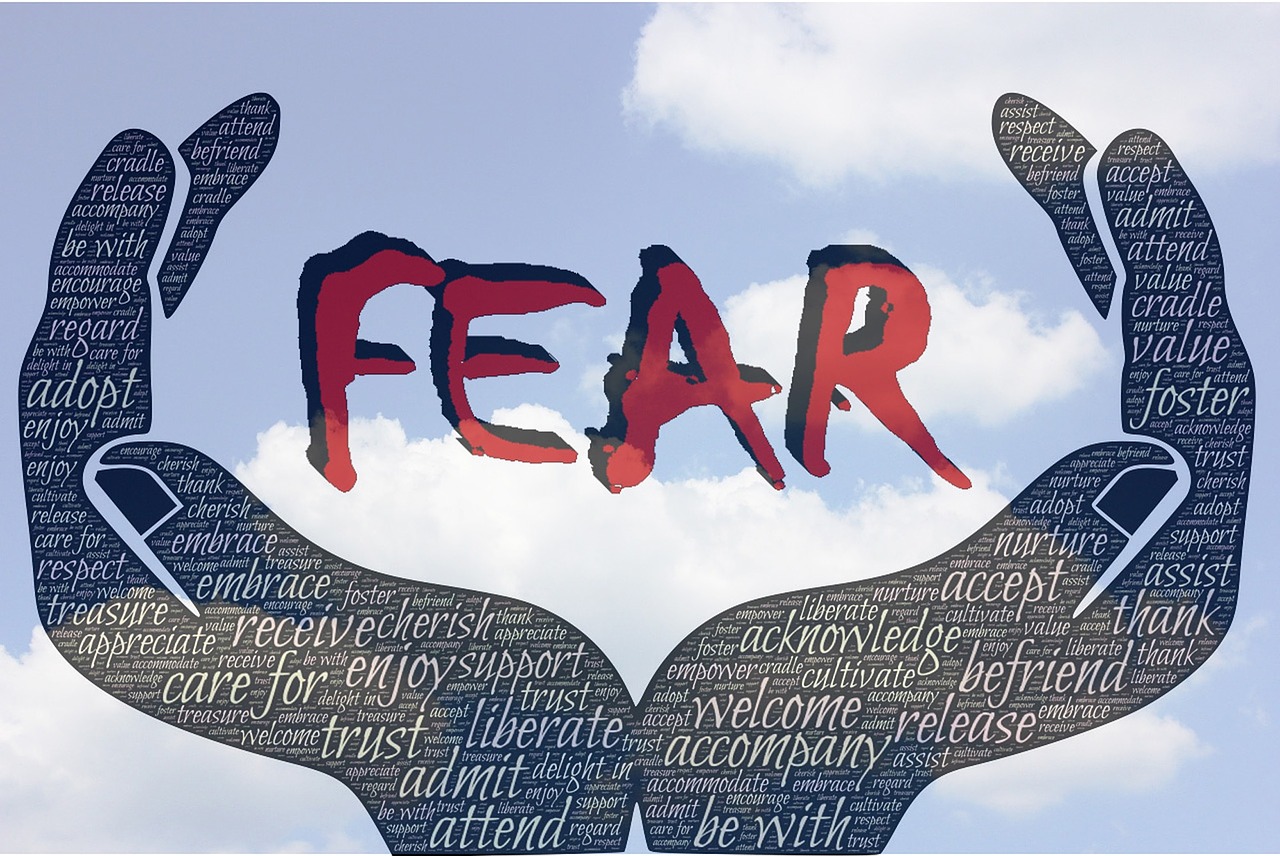
Being afraid of our fear only serves to further disempower us. When held with love, however, the energy of fear will dissolve. While it might be counter-intuitive, understanding and making space for our fear can be its greatest antidote.

When you feel yourself tighten in fear, I invite you to pause. Breathe. Send acceptance to your fear. If you wish, you can imagine you are holding a wounded and scared animal—with great tenderness and compassion. Allow your own presence and love to start melting the fear. And you may feel the scared younger part inside of you start to relax and soften.

“A further sign of health is that we don’t become undone by fear (…), but we take it as a message that it’s time to stop struggling and look directly at what’s threatening us.” – Pema Chödrön 
© Jenny Brav


The Frequency of Fear *2022-02-03T14:43:04+00:00
Go to Top