Making the Mundane Sacred *

“There is no mundane dimension really, if you have the eyes to see it, it is all transcendental.” – Terence McKenna

One of the invitations I have been receiving in the past months is to make the mundane sacred. By slowing down, and bringing both presence and reverence to each moment, we not only elevate our experience of life but also our own vibrational state. The current cultural norm of toxic productivity has us rushing from one thing to the next with our eye trained on the future while we frantically tick boxes off our list. This leads to: stress, burnout, emotional and physical tension, disconnection, depression and/or frustration and dissatisfaction.

On the other hand, when we really take the time and live each task or experience to its fullest, we are able to experience much more ease and joy in our relationships and our creative/professional endeavors. And we then naturally start sloughing off anything extraneous to our well-being and contentment.

Here are seven simple tips for making the mundane sacred (with a bonus poem at the end)

1) Slow down

While this is self-explanatory, most of us are conditioned to speed up and get really busy during the big, transitional times. However, the more we breathe, take breaks, spend time in replenishing activities (whether that be in nature, meditating, taking a bath/shower, creating art, gardening, working out, connecting with loved one and so on) the better we’ll be able to navigate things with ease.

2) Declutter/tidy your space

It is difficult to slow down and touch into gratitude/reverence when the space we’re in is cluttered. And our internal and external state often impact each other in either a positive or negative feedback loop. The invitation here is to start with what you are doing/where you are in the moment. If you are about to cook, make sure the kitchen counters are clear. Before you work, clear off your desk (more about that below). Planning a big spring cleaning/decluttering (although it may organically turn into that) is likely to overwhelm you and make you want to put it off, or clean from a rushed and contracted place. So start small.

3) Have ritual/grounding objects in your work/living space

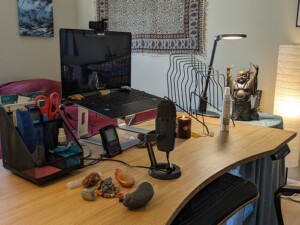
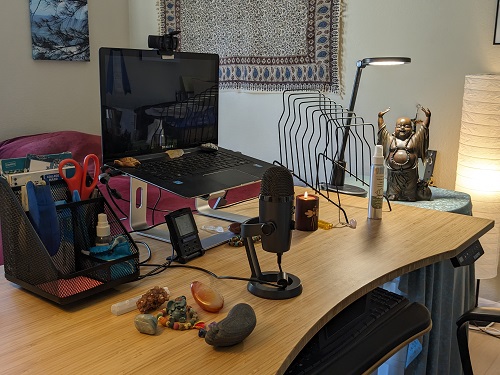
Having objects that have meaning for you in areas that you spend a lot of time in (such as the bedroom, your desk, the kitchen counters, your home gym area etc.) can help you connect to a deeper sense of relating to whatever you are doing. For example, I have rocks, crystals and other objects on and around my computer to help ground me and be a clearer channel during sessions and when I write. It also helps me remember the bigger picture when I’m doing tasks I might otherwise dislike (like taxes, paying bills, doing marketing etc.). Personalize this invitation in a way that makes sense to you.

4) Bring your breath and gratitude to what you’re doing

An easy way to bring more presence to whatever you are doing is to take a few deep breaths before starting. I also like saying “Hi” and “thank you” in my head to whatever I’m doing or whoever I’m interacting with (and “thank you, bye”) to mark the start and beginning, and to tap into gratitude. That may be appreciation for myself, or for whatever the activity or interaction is bringing me.

5) Be in the process rather than the outcome

Again, this is both self-explanatory but also counter-cultural. We have been trained to “keep our eye on the prize” and always focus on our plans and goals. And while that might help us with our accomplishments, it often diminishes our enjoyment of our lives and what we do have, since we end up focusing all our energy on what is currently missing. In truth, being process oriented and reaching our goals doesn’t have to be mutually exclusive. In fact, I’ve found that when I’m in the moment-to-moment unfolding of experience, following where the energy is rather than pushing things with my mind, I manifest what I want much more easefully, and sometimes way beyond what my brain thought was possible.

6) Focus on the deeper meaning of the moment

When we are rushing from one thing to the next, it is easy to take things for granted, or see things/people as a distraction. Which can create a general feeling of frustration, dissatisfaction, and—further down the line—regret at not realizing what we had. If we slow down and get out of “ticking things off our list” mode, we can remember to appreciate whatever is in front of us. Paying a bill is an opportunity to be grateful for whatever it is providing us. Going shopping, we can appreciate we have the money for and access to nourishing food. Showering can be a ritual cleaning activity, and so on.

7) Make it simple (and everything can be sacred)

If you like elaborate rituals and have time for them, by all means do that. But most of us get overwhelmed if something feels too difficult, and then we don’t do it. This does not have to be complicated. Do whatever feels accessible, easy, and enhances your enjoyment of life.

Life as Sacred Ritual

Give yourself space

Spread your wingspan
to full capacity

Out, out, out…

till you touch
the immensity
of possibility
when you live
in Infinity

The only limits
are self-generated,
trauma perpetuated

B R E A T H E
your lungs

out, out, out…

beyond distorted prisms,
twisted stories
imprisoning potentiality

E x p a n d
into the
unknown

Elevate drudgery
into art

Make the mundane
a sacred ritual

Reclaim sovereignty
over experience

Let the mystery
dissolve matter
until you float
in the bliss
of beingness

© Jenny Brav



Making the Mundane Sacred *2024-05-20T14:26:08+00:00

Living Your Purpose*

Do you ever feel like there is more you are meant to be doing with your life? Perhaps you have a clear sense of what it is, but there is always something that seems to get in the way of you actually doing it (or doing it fully). Or maybe you have just a vague nagging sense that you are not fulfilling your potential.

shutterstock_70744276My Story

From a young age, I had a clear sense that I was meant to be of service to others. This led me on an exploration of different ways to fulfill that purpose, including spending close to a decade working on international human rights issues in conflict zones in Asia and the Middle East.

In 2004, I had an internal crisis that led me to question my purpose. I was working in Indonesia at the time, and the area where we had been accompanying human rights activists was under martial law. Internationals had been kicked out, and we were reporting on the human rights abuses from afar. We felt helpless to do anything, and tensions within the team were high. After months of this, I developed repetitive stress injury in my arm, and eventually had to leave to take care of my health.

I went into a period of deep questioning: if this was what I was meant to be doing, why hadn’t I felt that sense of cosmic alignment and ease I get when I’m on the right path? I started meditating, doing yoga, and studying Chinese Medicine to heal my body, while continuing to work in the human rights field, this time in Nepal. During a process of soul searching, I eventually took a leap of faith in 2010, and moved to the East Bay. It has been an ongoing journey of clearing blocks and coming into ever deeper connection with my soul’s guidance.

These are some tips that I learned along the way, along with a guided meditation to help you get in touch with your life purpose.

Connecting to Your Inner Wisdom

The first step to living your life purpose, is to be connected to your own wisdom. This might be through guides or having a gut feeling which you follow. You might get support from others in the process, but ultimately you want to be able to access your own information. Some of my favorite methods include automatic writing, movement, meditation, being out in nature, and through body awareness. I have learned to pay attention the moment my body contracts, because that’s its way of telling me that something isn’t right. I discovered the hard way that each time I’m not paying attention, or I override my own no, it gets more and more difficult to access my intuition.

How do you connect to your intuition? Do you have a clear sense of your yes and your no? What happens when you override your own guidance?

Asking Your Knowing

This may take some time, but once you feel clear about how you connect to your own intuition, you can practice with small daily decisions. When that feels comfortable, ask yourself: what is my life purpose? This might be during a meditation, working out, driving, being out in nature, or through a form of creative expression. And just see what comes to you. You might get a felt sense of it, hear words, or see images. Whatever it is, just let it come to you. It may come to you right away, or it may be a process that unfolds over days, weeks, months, or even years. The main thing is to trust the information you get. Often, we are expecting something earth shattering. But it might be very simple. In my experience, our life purpose is more often about our being-ness and the qualities we embody, than anything we might do.

Intention Setting

The next step to living your life purpose is intentionality. While this has become a buzz-word, especially in spiritual circles, I have found it to be one of the keys to fulfilling my potential. It is all too easy to get caught up in distractions and the mundanity of daily living. Your intention might be to get clearer about your life purpose.

In the morning, I set an intention for the qualities I want to embody that day. At the end of the day, I review my day for what I am grateful for. When I forget to do this, I find it is much easier to take the things I have for granted, and to focus only on what isn’t right about my life.

Knowing your Saboteur

The closer we are to living our life purpose, the more likely it is that our protective strategies kick in. This is because somewhere along the way, we learned that it wasn’t safe for us to be all we could be. We fear ridicule, failure, or punishment if we are too visible or don’t fit in with the mold. We may also have a strong fear of the unknown or of change, so that we hang onto what is familiar.

How do you know when you are in resistance? Do you start distracting, avoiding, or acting out in some way? Do you start focusing on others and what they should be doing differently? Once you start recognizing your inner resistance, you can begin to befriend it. What is it trying to tell you? Is it afraid? Does it want you to slow down? After you get a sense of what your saboteur is trying to achieve for you, you can send it gratitude for trying to protect you, even if its tactics may be a little outdated.

Living a self-actualized life is always a dance between setting intentions for yourself, and then letting go and surrendering to what is. In the end, living your life purpose is not about achieving something external, or becoming something you aren’t. It is about clearing the voices of doubt and fear so you can access more of what is there already. The following guided meditation is intended to help you get more fully in touch with your purpose. Enjoy the journey!

Guided Meditation for Finding Your Life Purpose

© Jenny Brav


Living Your Purpose*2024-04-09T09:48:26+00:00

Releasing Limiting Beliefs *

Is it challenging to create the life you know you deserve? Do you find yourself repeating the same patterns over and over again?

“Learning too soon our limitations, we never learn our powers.”Mignon McLaughlin

As children, we all experienced some level of wounding due to unmet needs and/or direct trauma. As a result, we subconsciously developed beliefs about ourselves or the world to help explain what we were experiencing. For example: “I’m not enough,” “Others can’t be trusted,” “I can’t make mistakes,” “I need to stay small to be safe,” and “I don’t belong.” These beliefs in turn led us to adopt coping strategies to try to manage in a world where “not belonging” was our daily reality.


While these beliefs have the adaptive function of trying to make sense of our circumstances in the best way we can when we are children, if we don’t become aware of them and actively work on changing them as adults, they can truly hold us back. When old, outdated beliefs are still running us, we may attract situations that serve to reinforce them – until we are able to see them as opportunities for healing and clearing.

The following are 7 tips for releasing limiting beliefs:

1) Notice when you’re contracted

Limiting beliefs are often so difficult to identify, because they feel 100% true in our bodies and psyches, and every instance that triggers those feelings appears to be further proof of their veracity.

In order to become aware of these beliefs, I invite you to start paying attention to your physical sensations. Limiting beliefs are by definition tight and constrictive. Notice when your body feels contracted. What thoughts or emotions (such as fear or anger) are present?  What are you telling yourself about the situation? I also invite you to track recurring patterns, as they are generally a sign of a limiting belief needing updating.

2) Identify your beliefs

Now that you’ve started tracking recurring patterns and feelings of contraction, I invite you to jot down beliefs that might be associated with them. For example: “I’m unlovable,” “The world is out to get me,” “I’m only safe when I’m in control,” and “I have to be perfect to be accepted.” Once you have identified the beliefs, you may think about recent (or not so recent) situations that seemed to prove this belief true. How pervasive is this belief in your life?

 3) Trace the belief to its origin

If you have listed more than one belief, pick one that feels particularly charged or current. What does it feel like in your body when you feel into that belief? Is there an area that feels tight, achy or fluttery, for example? Or, conversely, do you leave your body? Imagine that you are tracing that feeling back in time, to a time when you first started believing this. Is there a memory or timeframe associated with it? What was happening at the time? If nothing comes up for this question, you can always skip it.

If it feels like you always had that belief and can’t trace it back to a specific time frame or memory, then you may have inherited the belief from your parents, caregivers or other family members. What were their circumstances that might have led to that belief? If you do not know, that’s OK.

4) Identify the wound

We develop beliefs in order to try to compensate for wounds and/or unmet needs. Imagine that you are lifting up the belief you identified (for example, “I can’t rely on anyone but myself”) and looking underneath it. What is the emotion underneath the belief (i.e. grief, terror, anger, loneliness, helplessness, and so forth)? What is the unmet need? This might include the need for safety, love, acknowledgment, connection, autonomy, for example. If you traced the belief back to a family member, you may want to guess what their unmet need was.

5) Send empathy to the belief

I invite you to send empathy to the part of yourself that developed this belief in order to somehow soothe the pain of the unmet need. If you accessed a memory linked to this belief, you can send the empathy to your younger self. You might acknowledge that it was smart to develop this belief as a result of your circumstance. You can do the same with any family member you identified as being associated with this belief. If you didn’t access any memories/ancestors, you may just want to put your hands on the part of your body that feels contracted. Close your eyes. Breathe, and allow yourself to feel the touch in that area. If you wish, you can whisper some words, such as “it’s OK.”

6) Upgrade your belief

Although the limiting beliefs we develop are often adaptive, when we don’t update them, we may end up recreating the very situation that wounded us in the first place. For instance, let’s say a child has parents who are so busy they don’t have time to pay attention to her. She might feel sad and lonely because her need for connection and affection isn’t being met. She develops the belief that she is unlovable. Due to that belief, whenever there’s an opportunity for her to get close to somebody she does something (unconsciously) to push them away. As a result, the belief she is unlovable and her feelings of sadness/loneliness are reinforced.

Ask yourself if you are ready to let go of this old belief. If you feel any tightening, anxiety, or doubt, then it probably means that part of you isn’t ready. I invite you to continue tracking the impact of the belief, and giving yourself empathy. If you feel an opening internally, lightness or a feeling of excitement in response to the question, then it means you are ready for the upgrade – to install the 2.0 version of the belief that matches your current circumstances.

What new belief would you like to have to replace the old one? For example, “it’s safe for me to ask for help.” You may want to write down the old belief, cross it off (or tear it up) and write the new belief. This could also be done as a ritual (i.e. lighting a candle, with a picture of your younger self) if that is a practice that resonates with you.

7) Find other ways to meet the unmet need

If you identified an unmet need, ask yourself if are there other ways you could try to meet that need. In the above example, if the emotion was loneliness and the unmet need was connection, what are ways you might meet that need? And as the outside world is often a reflection of our internal state, I invite you first to make a list of ways you might connect to yourself more. For example by reducing distractions, and making time for things that are nourishing for your mind, body and soul. Make a list of things you love doing, such as dancing, working out, eating good food, getting a massage, etc. See if you can do at least one a week. Once you feel more connected to yourself, you can make a list of things you could do to start building a sense of community.

Wishing you the best of luck in releasing the old beliefs and accessing your full potential.


Copyright © 2018 by Jenny Brav. All rights reserved.   

Releasing Limiting Beliefs *2023-07-25T15:27:40+00:00
Go to Top