Blog

Channeled Wisdom About Manifesting


Manifestation refers to the magnetization of energy that happens when you are in alignment with source energy, in flow with your own knowing. It is not an action but a state of being, or a chain reaction that happens in response to that state of being.

Think of molten earth and ocean currents. Of refracted sunrays radiating their magic down on earth.

Focus on the process—the qualities that want to be embodied—rather than the outcome.

Trust that if you aren’t manifesting what you think you want, synergistic source energies will provide what you need instead.

And when you trust and surrender fully—putting your heart in the driver’s seat, rather than your mind—the possibilities that open up will go far beyond what your mind can ever imagine.

© Jenny Brav

Channeled Wisdom About Manifesting2023-12-20T12:58:39+00:00

New Beginnings *

What would you like to bring into your life in the New Year? Are there events or patterns from the past year you would like to clear?

“Write it on your heart that every day is the best day in the year.” – Ralph Waldo Emerson

“Your success and happiness lies in you. Resolve to keep happy, and your joy and you shall form an invincible host against difficulties.” – Helen Keller

As the earth tilts towards longer days, and the Gregorian calendar closes on another year, it is a good time to pause and reflect. Having spent many moons in countries that were on another calendar system altogether, I know how arbitrary the concept of the New Year (and when we celebrate it) is. And yet I find value in ritually acknowledging closings and new beginnings. It is all too easy to get caught up in the cogs of daily life and lose sight of the bigger picture of our soul’s desire for this lifetime.

The following are 6 suggestions for what I find to be a powerful ritual to greet in the New Year. You may want to bring out a few sheets of butcher paper, paints, crayons, magazine cutouts etc. to get creative. Doing this celebration with friends is fun as well. Although the following suggestions are tailored to welcoming in the New Year, you can tweak them for any ritual celebration of a new beginning.

1. What you are grateful for

Our minds are conditioned to focus on the negative for survival reasons. Gratitude practices are one way to start shifting our perspective so that what goes well in our life carries as much weight as what doesn’t. On one sheet of paper, write all the things you are grateful for in the past year. You might write down different areas in your life that are relevant, such as friends and family, health, work/education, home, creativity and inspiration, nature and outdoor activities, and so on. Or you can divide your year by month or quarter, if each one had a different flavor for you. Be as specific as possible.

2. What you are letting go of

Scan the different events of the past year and your reactions to them. Is there anything from the past year that is still having an impact on your thoughts and your nervous system that you feel ready to clear? Did some of your habitual patterns show up (such as blaming others, feeling overwhelmed, overriding your own boundaries etc.)? On a separate sheet of paper, write a list of what you want to let go of. You can keep this list as a reference point, or you can have a letting go ritual where you acknowledge the patterns for how they may have served you at some point, and then release them. You may burn (if you can do that safely) or tear up the list. Or you may brush the patterns off your body and imagine you are cutting any energetic cords that are still tying you to them.

3. What you learned

Now imagine that you are taking a bird’s eye view of your year, or that you are looking back on this year 5-10 years from now. Feeling into the challenges you faced, ask yourself what were you learning (whether you were aware of it or not) from those struggles? For example, were you learning to let go of control, to be patient, to trust, to know yourself better, to meet your own needs, to let go of a sense of victimhood? This exploration can give perspective to the letting go list, so that instead of seeing the challenges as unwanted events – or looking at your patterns as parts of yourself you want to get rid of – you can start feeling into the bigger picture of your soul’s journey.

4. What you are bringing in

Feel into what you would like to bring in for the next year. This can be qualities, such as equanimity, grounded-ness, trust, levity. Oftentimes what we are bringing in is closely link to the lessons we are learning. Write down the list on a separate piece of paper. Pause with each one, and really feel each quality in your body. What would it feel like to live your life from this place?

5. Specific goals/intentions

You can stay with the previous list of qualities, or if you wish you can refine it to include specific goals/intentions for the next year in your professional and personal life. What are you wanting to manifest more of in your life? I recommend being specific with your goal, and also keeping the list fairly short (for example, 3 for each category). In my experience, if I have too many goals they actually get diluted in my ability to create them. In an earlier blog post (“From Intention to Reality,” including a manifestation audio meditation), I wrote about how to identify and clear some of the blocks that might be getting in the way of realizing your dreams.

6. Asking for support

Many of us start the year with great intentions, and then quickly lose motivation. I find it helpful to have my goals somewhere visible, where I can see them every day. Asking for support from a friend to check in with you can also bolster accountability and a sense that somebody else cares if we complete our goal. If you work with any form of inner guidance, ask your guides/higher self/higher power to make this a reality. We often vacillate between a sense of needing to control and manage everything, and a feeling of overwhelm and collapse. In my experience, I am best able to create what I want with ease when I imagine I’m co-piloting my life with the universe – this continual dance of setting the course and then letting go and trusting.


New Beginnings *2023-11-27T19:26:46+00:00

Letting Go of Your Old Stories *

Do you have stories about yourself or the world that define your life? Are there certain patterns that keep on repeating throughout your life?

When you hold onto a script that doesn’t serve you, you leave no space to write a new one that does.” – Jennifer Ho-Dougatz


Many of us have old stories or beliefs about ourselves and the world that rule our reactions and how we perceive things. We develop these beliefs in order to make sense of our circumstances, or in response to what others tell us. These beliefs or stories often enable us to overcome, or at least explain, difficult situations.

For example, a client who grew up in a war-torn country developed the belief that the world was a cruel place and that she could only depend on herself. This gave her the strength she needed to leave when she was 17, despite being terrified and alone. Decades later and living in very different conditions, however, this belief led her to fear and try to control the unknown, and was holding her back from thriving. Another client, who grew up in a large family with a mother who was overwrought with meeting the physical needs of her many children and couldn’t tend to their emotional needs, learned that his needs didn’t matter. Decades later, he would lose his sense of self in the face of his family’s demands, and was struggling to find his own identity.

The following are five tips for understanding and letting go of your old stories, so you can make space for new possibilities in your life:

# 1: Track recurrent patterns and internal conflicts
Whenever we experience patterns that keep on repeating themselves – be they in our relationships, work environments, or living situations – there is likely to be an old wound that’s wanting healing.

Start writing down conflicts or difficult situations you are currently dealing with or have in the past. Is there something familiar about this situation? Once you have listed some of your struggles, see if you can identify similar patterns that keep coming up for you. Track those patterns to determine if they occur most often in one type of situation (for example, at work or in your personal relationships) or if they are present across the board.

# 2: Make a list of your beliefs
Now that you’ve started identifying recurrent patterns in your life, I invite you to explore the beliefs about yourself that may be at the root of those patterns. One way to do that is to notice the stories and feelings that come up for you around the situations you listed in # 1. How do you feel? Invisible, like your needs don’t matter? Like others can’t handle you, that people are manipulative, that you are less than others? Next to the list of your patterns, start making a list of the beliefs about yourself and the world that you have identified.

# 3: Trace the beliefs back in time
Now that you have identified your beliefs, track them back in time to when you first started feeling something similar. What was happening at the time for you? How were you learning that your needs didn’t matter, or that the world is cruel, or that you would always be abandoned? They may have developed as a result of one traumatic incident, or of multiple similar incidents over time.

# 4: Acknowledge your story for its intention
We develop our beliefs and coping strategies for good reasons. And oftentimes, our automatic responses and ways of understanding the world were generated at a very young age. Send empathy to your younger self for the circumstances that led them to create the narrative they did at the time. If appropriate, also send acknowledgment to your story for having served you in some way. For example, it pushed you to try to be the best, or stay under the radar, or to put others first. And let your younger self know that your circumstances have changed, and that if you let go of the old story, they will be able to get what they most wanted back then but couldn’t have. For example, love, validation, the ability to be completely themselves.

# 5: Start writing your new narrative
Look at your list of beliefs and patterns. These are the unconscious blueprints with which you are running your life. It’s like a computer that’s still running on a very old operating system. And begin to write the new beliefs and new narrative you would like to have about yourself and the world.

When you feel the old story and feelings comping up again, I invite you to pause. Send your younger self love. Remind yourself that just because the old belief feels true (since you’ve been replaying this track over and over again for a long time) doesn’t mean it is true. And look over your list of new beliefs, picking one or two you want to focus on anchoring. Repeat this new belief to yourself whenever you notice yourself running the old program — until someday, this new belief becomes your new baseline.

Don’t spend your life believing a story about yourself that you didn’t write that’s been fed to you – that simply you’ve accepted, embedded and added to. Let the story go and there beneath is the real you…and your unique gifts, heart and path that await you.
– Rasheed Ogunlaru

Unraveling Old Stories

I unravel the old stories
Reified into my veins as truth.
As I untangle gnarled knots
Of “I can’t” and “not enough,”
Of overwhelm and anxiety,
They stream out
In colorful garlands
Of ease, trust, and adventure,
Paving the way
To new horizons —
Free from the fetters
Of my past.

© Jenny Brav


<


Letting Go of Your Old Stories *2023-12-31T19:11:36+00:00

Chronic Health Issues *

Do you struggle with chronic pain and/or illness? Do you find it hard to have a good relationship with your body because of it?

I was recently diagnosed with a fairly rare connective tissue disorder. While I was relieved to finally have an explanation for myriad inexplicable symptoms I’ve had my whole life, the diagnosis also opened up a whole world of testing, supplements, and alternative treatments which often highlighted my body’s limitations more than anything else.

Through this journey, which I know is just beginning, I have been grateful to have my own set of healing tools and practices to help keep me grounded in a deeper truth, maintain a loving relationship with my body (to the extent possible), and prevent me from spiraling into fear.

I send so much empathy to whatever health issues might have brought you here. And I hope the following suggestions might help you on your journey.

1. Access your Emotions

The first step is to allow whatever emotions might be there to arise. That may be fear, sadness, overwhelm, anger, powerlessness, confusion… Writing a list can be helpful. And then I invite you to say hello to each one by name.

2. Access Beliefs Being Triggered

Next, notice any beliefs that may have been triggered by your pain and/or condition, as well as your journey for getting support, if it’s relevant. For example “I’m all alone.” “Those in charge have no idea what they are doing.” “I’m so unlucky.” “Just when you think things are okay, disaster strikes…” Whatever it may be. Again, writing them down, and saying hello to each one can be helpful.

3. Trace the Beliefs to childhood.

Notice if the emotions and beliefs feel familiar. If they do, you might want to trace them back to your childhood. Imagine you are sending empathy to any young part of you that was developing those beliefs.  If this feels highly emotionally charged and you want to go deeper into this work, this blog post (and YT video) might help: https://www.radiantwholenesshealing.com/healing-childhood-and-family-wounds/.

4. Connect to Your Body

When we are in pain, taking strong medications, and/or things are happening in our body we have no control over and might not understand, connecting to our bodies might feel difficult. Or terrifying. This is understandable. And yet, from my perspective it’s impossible to heal the body if we are not connected to it.

I invite you to sit or lie in a calm space. Close your eyes. And start feeling into areas of your body that feel tight, painful, and/or agitated. Take ten slow breaths (to the extent that’s accessible) in and out of the area. Imagine each breath is bringing compassion and care to the area.

As you drop in more deeply into your body, you might feel into the quality of the pain/discomfort. Ask yourself “if my body could communicate with me, what might it be trying to convey.”

5. Connect to Your Fear

For most people, wherever there is chronic pain/illness, there is fear (and if that’s not the case for you, you can skip this part). Although we said hi to all the emotions in #1, it can be helpful to spend extra time with the fear.

If possible, place one or both hands on any part of the body that feels like it’s needing attention (the heart and/or abdomen are often good places to start). If that is not physically possible, you can imagine it. Send care and compassion to the part of you that is scared. If you feel called to, you can say some reassuring words. “I know you’re scared. It’s okay to be scared. And you’re not alone.”

6. Connect to a Healthy Future Self

If it feels available to you in this moment, imagine a future of parallel version of yourself who is healthy. Imagine that you are stepping into that space with them. Let them know that you are a version of them that isn’t as healthy. Ask this future/parallel self for any message. Merge with them. Feel what it’s like in your body to be merged with them. Bring this feeling into the crown of your head, feel it spread through your neural pathways, and your whole body.


© Jenny Brav 2022

Chronic Health Issues *2023-12-19T13:03:03+00:00

Step into your Bigness*

“Our deepest fear is not that we are inadequate. Our deepest fear is that we are powerful beyond measure. It is our light, not our darkness, that most frightens us” – Marianne Williamson

In a recent session, a client who has chronic physical pain saw herself unzipping the small, narrow suit she has been trying to fit into since her childhood, and stepping into a big, unlimited self. Her big self (which can also be seen as her essence, or whole self) was free from old patterns of either needing to collapse to be safe, or fight back to try to assert her autonomy. Her body—and in particular her joints and nerves—had so much more space to breathe when it wasn’t trying to fit into others’ ideas of who she needed to be.

Although the degree can vary widely, all of us have been wounded. As a result, we developed beliefs and coping strategies to help us understand and manage those wounds. When our circumstances change, but our beliefs and strategies do not, the latter end up perpetuating the very thing they were designed to fight against. Crises (physical or emotional, internal or external) and feelings of stuckness are usually an indicator that a part of us is ready to grow and evolve, while another (usually younger) part of us is clinging to the old strategies for dear life, terrified of what the consequences might be if we let go. The way forward is for the young self to feel heard, held and acknowledged, while simultaneously realizing that the situation has changed, and that it’s safe to let go.

Here are five tips for accessing your bigness and stepping into your power.

1. Notice your small self

Start tracking what it feels like when you are triggered, reactive, or shut down. How does your body feel? What is your posture like? What are you believing about yourself and the world? Is there a pattern to what triggers you—such as feeling misunderstood, or like you don’t matter? I invite you to keep a journal for a week or more to take note of this.

2. Explore the origins

When we are triggered, we are usually filtering and reacting to the world through wounded child eyes, even though the arguments we use to justify our reactions may tap into our adult faculties of reasoning. When you are feeling reactive or collapsed, ask yourself “what age is associated with this response?”

If nothing comes up, I invite you think about your childhood. If there was an age when you started learning X (whatever belief you identified in #1), what age/ages might it be? It might also be a timeframe more than one age. What were the situations or the people you were learning that from?

3. Send compassion to your small self

Imagine that your adult self is with that young part of you. What would have been helpful to hear back then? For example, “It’s not your fault.” “I’m proud of you.” “You’re not alone anymore, I’m here.” “You did exactly what you needed to do.”

If it feels appropriate, imagine that you are projecting images of your current life to your young self/selves. Let them know that their situation isn’t going to be like that forever, that things are going to change, and that you have resources they didn’t have.

4. Step into your big self

I invite you to close your eyes, and feel back into that feeling of a small self. Imagine that in front of you is your big, wise, essential self. If that’s hard to call up, you can also bring in a powerful energy/being you feel resonance with. For example a tree, a tiger, a mountain, a spiritual teacher or religious figure. Visualize yourself unzipping your small self, and stepping out of it. You can do that as slowly as you need to, over several days or week if necessary. When you are ready, feel yourself merging with your big and wise self and/or with the powerful being you called in. Notice what that feels like in your body. What does the world feel and look like when you look at it through your wise self eyes? Once you feel somewhat comfortable with this big version of you, you may want to bring up a person or a situation that has felt problematic to you. Does looking at it through these eyes shift your perception?

In a recent session, a client of mine merged with mountain energy. When she looked at people who had always been intimidating to her young self through mountain eyes, they seemed much smaller. She could see how they were trapped in their own pain.

5. Creative depiction

I invite you to find a creative way to further anchor this version of you into your body and subconscious. When I say creative, I’m referring to whatever way you have of accessing a deeper part of yourself. You could do this as a guided meditation, or feel yourself stepping into your bigger self as you are hiking, walking, biking, running, swimming, paragliding… You can draw/paint it, write a poem on the theme, or dance the transition from small self to big self. You could do a body sculpture or mime it. A combination is also possible. I wrote a poem entitled “Ode to my small self,” drew a picture of myself shedding the old patterns and fully stepping into my essential self, and have been visualizing it in some of my daily meditation practices. Just in case the universe didn’t get it the first time.

I wish you luck on your journey, and feel free to leave a comment on how that went for you.

The following is a guided meditation for stepping into your wise self.


© 2020 Jenny Brav


Step into your Bigness*2023-06-20T11:50:38+00:00

Inner Child Healing Excerpt from The Unbroken Horizon

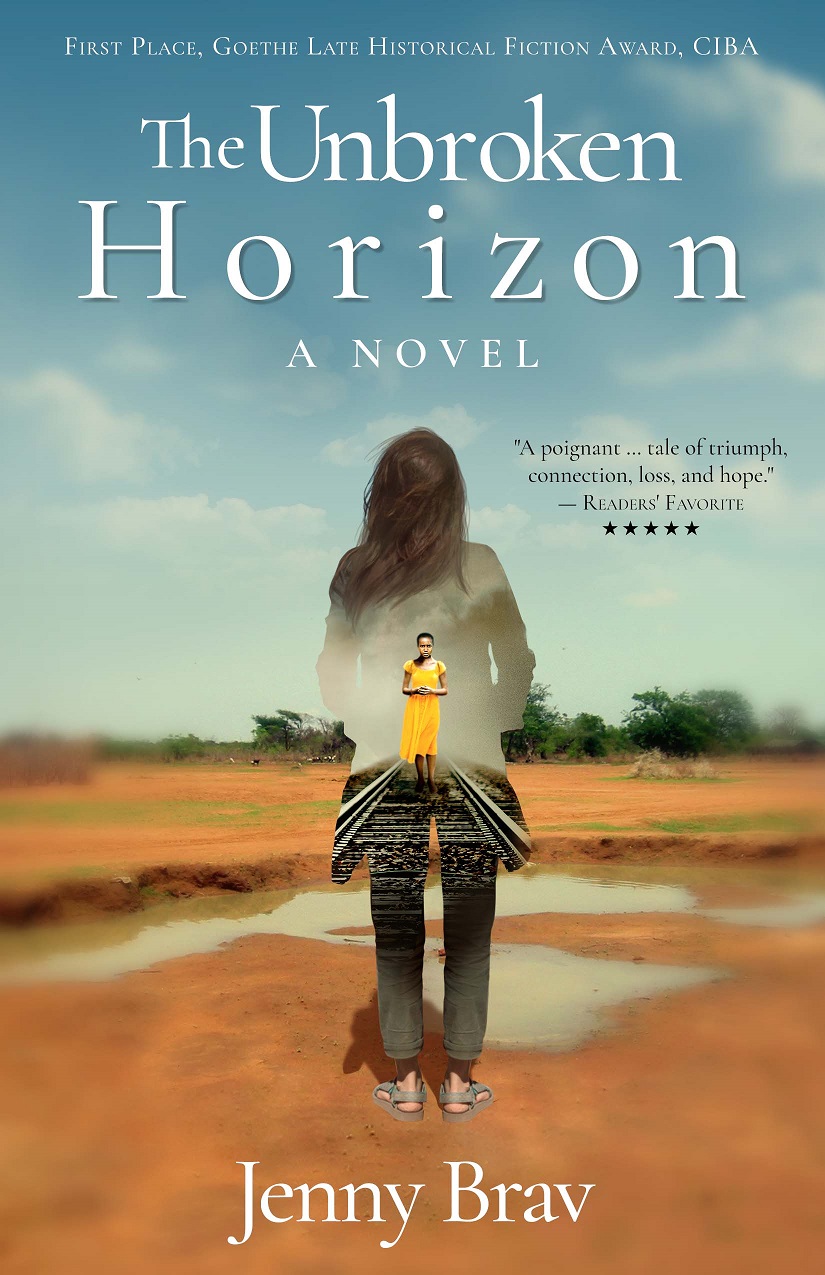
In my debut novel The Unbroken Horizon, first place winner in the CIBA awards for late historical fiction, one of my main characters goes on a journey to heal her childhood wounds, In the following passage, Sarah, a 34-year-old humanitarian nurse, has just re-read journal entries from when she was thirteen. At the time, her father had just died of a sudden heart attack, and her surgeon mother decided to take a Fellowship in Paris, and cart her grieving daughter half-way across the world.

As you read it, I invite you to feel into what age (or age range) is clamoring for your attention? What beliefs was that child part developing about him/herself? What would you want the younger you to know? What new beliefs would you like to replace the old ones with?

I closed the journal, feeling a tight ache in my heart, reliving both the powerlessness and the rage. My mother loved structure and precision, hence her career as a surgeon. She couldn’t stand the messiness of emotions. Teenage drama especially got her hackles up, so I had had to swallow my indignation and go along with whatever decision she made, all the while fuming inside. I didn’t think my mother had ever been an adolescent. I imagined her born with a scalpel in her hand and a string of obsequious interns hanging on her every word.

Leaning into that time in my life and remembering my session with Patrick [her therapist], I wondered what my younger self was learning then. I reopened the journals and reread the last entry.

“Thirteen-year-old Sarah. What are you learning?” I asked, and closed my eyes.

After a second or two, the words started coming. Opening my eyes again, I grabbed my current diary, and started writing what came to me without thinking too much:

“I can’t trust anything.”

“I will lose the people I love. There’s no point in getting too attached.”

“I have to forget the past and keep moving forward, no matter the cost.”

I paused, noticing a tight lump in my chest. My breathing was shallow, and with great effort, I attempted to slow it down.

“You still live your life that way,” I berated myself. From my work with Patrick, I was starting to see the ripple effect of that belief into the next twenty-plus years of my life.

I felt overwhelmed. Could I really heal that pattern? It felt so deeply ingrained. And if I did, who would I be?

Next to the February 28 entry, I wrote a possible new belief for myself.

“What if it’s safe to trust?”

I put my hands on my heart and whispered to my thirteen-year-old self: “That’s what I want for you.”

“Yeah, right, as if!” I imagined my teenager retorting.

My legs were feeling antsy and tight again, so I decided to go for the run I’d skipped earlier. When I came back, I felt a little lighter and calmer.

© Jenny Brav

Inner Child Healing Excerpt from The Unbroken Horizon2023-05-30T13:55:39+00:00

Balancing Your Inner Masculine and Feminine *

Can it be hard for you to be tender and receptive? Conversely, do you find it difficult to be decisive and get things done? 

“If any human being is to reach full maturity, both the masculine and the feminine sides of the personality must be brought up into consciousness” 

– Mary Esther Harding

All of us have feminine and masculine qualities. When those energies are balanced within us, we feel integrated and able to manifest what we want in life fluidly and effortlessly. However, most of us have some wounding around the masculine and/or feminine that can make it difficult for us to access that sense of flow and integration. These wounds often have compounding factors such as:

  • our relationship with each of our parents (or guardians)
  • our parents’ relationship to each other (or lack thereof)
  • messages we received about masculinity and femininity from society, religious teachings and/or our peers
  • messages we received about our gender identity and/or sexual orientation
  • any wounding from our early sexual encounters
  • any trauma/abuse we have experienced

In Chinese philosophy, the concept of yin and yang encapsulates the importance of polar yet interdependent energies, and the need for these energies to harmoniously flow in and out of each other like the flow of the tides. The following are five tips to help you heal your relationship to your masculine and feminine energies. If you have deep trauma that you have not gotten professional support around or if you start feeling flooded as you read this, I recommend reaching out for external support before following these tips on your own.

# 1: Healing your mother wounds

Feel into the relationship (or lack thereof) you had with your mother. If you were adopted or a foster child, you can do this both with your biological mother (whether you knew her or not) as well as any female guardian/adoptive parent.

Ask yourself what messages you received from your mother about yourself and the world? Notice what emotions arise as you bring up that relationship. Where do you feel those emotions in your body? I invite you to breathe deeply into that area of your body, until there is a sense of calm.

Ask yourself if there is any particular age or ages needing healing? If not, stay with the emotions and physical sensations. If an age or a memory does come up, imagine that you are holding that younger part of you, and saying any of the following that feels appropriate: “I am so sorry that you learned that you are all alone/your needs don’t matter.” “I want you to know that none of this is your fault. It has nothing to do with you.” “Mom’s inability to care for you in the way you need is a reflection of her capacity/wounds. It has nothing to do with you and your worth.” “You are perfect as you are.” And start feeling into the possibility of letting go of unresolved baggage with your mother. Of giving back to her any message you might have absorbed from her about yourself and your worth. Do this until you feel more calm when you think of your mother.

#2: Healing your father wounds

Follow the same steps as above with your father or father figure.

#3: Healing your parents’ relationship within you

Often, our relationship to our own masculine and feminine mirrors either 1) the relationship we had with our parents, or 2) the relationship our parents had with each other (or both). If one of your parents was absent or died, you can think of any stories you heard about them.

You may want to take a piece of paper. In one column, write down the things you heard your parents say about each other (these may be positive, too). In another column, write down ways they behaved with each other in order to meet their needs. This might be yelling, nagging, avoiding or checking out, placating or giving in, trying to control the other’s behavior, betraying the other and so on.

Feel into your own relationship with your feminine or masculine, and see if there is any resonance with the list you wrote down. For example, does one part of you check out while the other nags and criticizes? Do you favor the qualities in yourself that mirror those of the parent you viewed as being more powerful or safer?

If it feels appropriate, imagine that you are calling your parents’ higher selves in front of you. You might place a picture or representation of them in front of you, drawing a circle around them. And imagine that you are giving back to them anything you might have taken on for yourself of their pattern. If you wish you can place the list you wrote down in the circle with them. “I honor you both and wish you well on your journey. And this pattern of ___________ is no longer mine to keep. I give it back, with love and compassion.”

#4 Healing from societal messages

Now, take another piece of paper and in one column, write a list of all the messages you received from society, your peers, the media, and religious teachings about how men and women should be. If it’s relevant, write any messages you received about your sexual orientation and gender identity. In another column, write a list of all the messages you received about which aspects of you were desirable. In a third column, write a list of the aspects of yourself or emotions you learned were not acceptable.

If the messages in the first column do not feel true to you (anymore), you can cross them out, tear them up or burn them (safely). Write another list of what you wish to believe or now believe about your feminine/masculine qualities, as well as your sexual orientation and gender identity.

Looking at the third column, imagine that you are calling back any of the parts of you you may have disconnected from which you like to reconnect with. This might be your vulnerability, your trust, your ability to express your needs, your power, your anger, your care, and so on. You can visualize them coming back to you through your crown, as gold light.

#5 Uncoupling the trauma from your masculine/feminine energy

When we have a difficult or traumatic experience with a female or male-bodied person, we often end up associating that person’s transgressions with masculine or feminine energy. While masculine and feminine energy are neutral manifestations of our own life force, we believe that the energy itself is not to be trusted.

If this is the case, imagine that you have two boxes. One representing the person who harmed you, and another box representing the energy (masculine or feminine) that you associate them with. And imagine that you are pulling those two boxes apart, so that the masculine/feminine energy feels neutral and free from the associations you have with the person. You may do this through writing or in a painting. Or you may imagine that you are showering the masculine/feminine box with healing and cleansing light.

Affirmations for anchoring the healing

Now that you have started healing some of your wounds around your feminine and masculine energy, you can read these affirmations to yourself, highlighting any that particularly resonate with you:

  • I am healing the residue of my mother wounds
  • I am healing the residue of my father wounds
  • Their inability to care for me in the way I needed is on them
  • Their inability has nothing to do with my worth
  • I am letting go of these old societal messages
  • I am reconnecting to the divine feminine within me
  • I am calling back my ability to trust and surrender
  • I have everything I need to nurture myself
  • I am reconnecting to the divine masculine within me
  • I am calling back my ability to manifest what I want in the world
  • It is safe for me to feel and express my power
  • I am letting go of my parents’ relationship to each other
  • I am learning to relate to myself in a healthier way
  • I am healing my old traumas and wounding
  • My masculine and feminine energies are integral parts of who I am
  • I am allowing myself to feel whole and balanced
  • I am allowing life force energy to flow through me
  • I am allowing this to be easy and effortless


© Jenny Brav

Balancing Your Inner Masculine and Feminine *2023-04-25T10:23:50+00:00

Turning Down the Noise *

Do you feel like there’s never enough time for you? Would you like more space to connect inward?

“Disconnect from everything long enough to see if it feeds your soul or if it’s a distraction. What’s deeply connected will always remain.” – Maryam Hasnaa

When we are caught up in the external noise of life (family obligations, work, distractive habits etc.), that generally means we are out of attunement with ourselves. This may be expressed as anxiety, fatigue, lack of self-care, irritation or depression—to name a few. In order to come back into harmony with ourselves, it’s necessary to turn down the outside noise. The following are a few suggestions for how to do that.

1) Technology detox
One of the most common forms of distractions these days is technology. Reaching for our phones is such an easy way to pass time and avoid feeling. A few months into the pandemic, I realized that my body and nervous system were impacted by the sudden shift to being online so many hours a day (for work, entertainment, socializing, exercising…). I started implementing a monthly internet-free weekend, which has been so helpful for resetting my nervous system. The last weekend of the month, I turn off my wi-fi and phone Friday evening, and turn it back on Monday morning (checking my phone once on Saturday and Sunday morning to make sure there are no emergencies). I do longer than usual meditations, journal and connect to my inner guidance, spend more time in nature, have quality time with my cat, write, and so on.

Some of the benefits are: deeper connection to self and to my intuition; feeling more present and focused; getting better sleep; slowing down; getting perspective on my life. While I know not everyone has the luxury of being able to do exactly what I described, there may be a way to adapt some part of it to meet your needs.

2) Minimizing Numbing/Distractive habits
In addition to technology, there are many habits that disconnect us from ourselves. This includes any addictive behavior (alcohol/drug consumption, food, shopping, gambling, sex/porn, compulsive thoughts and so on). While these behaviors are symptoms that something is needing loving attention, finding ways to minimize the behaviors can be helpful to make space to tune in. One of my clients has found the “Days Since” app helpful to track habits she’s wanting to do less of.

Conversely, it may be helpful to tune in (#3), give yourself compassion (#4), and start with nourishing habits (#5) before trying this one. Sometimes the distractive habits shift on their own when we are implementing the nourishing ones. Feel free to experiment and/or trust your intuition of what works for you.

3) Tuning in
I invite you to spend a little time every day (ideally) or week (depending on your time), tuning in with yourself. That can be through dance, spending time in nature, sitting in silence, journaling, painting, stretching… anything that helps you connect inward. This is best if the focus is on the process and not the outcome. In other words, you’re not trying to paint or write something “pretty,” or stretching to meet a fitness goal. While that is fine, it’s rarely conducive to a true tuning. Listen for any emotions or part that are feeling vulnerable and wanting loving attention (such as grief, fear, insecurity, anger, and so on). This could also be neglected parts such as your creativity and inner knowing.

4) Loving presence
Once you have connected with some part of you wanting loving attention, I invite you to spend some time bringing presence to it. That might be through putting your hands on your body (for example on your heart and/or belly). Doing a loving-kindness meditation. Saying affirmations. Breathing or humming. Whatever feels natural and good. Kristen Neff and Tara Brach are two spiritual teachers with many resources for self-compassion. EFT for self-acceptance can be helpful, as well.

5) Making Time for Nourishing Habits
Make a list of habits that you know are nourishing for you. You can either do this concurrently or once the parts are (hopefully) feeling more seen and heard. This can include any of the ways you used to tune in. And commit to doing one that feels manageable once a day for a minimum of 3-5 minutes. It doesn’t need to be anything big. I’ve found that 5-10 minutes of silence, stretching, and self-massage to start the day and/or close the day can have a profound effect on my clients’ feelings of well-being.

The Space in Between

The space in between
is where it all begins

The gap between words
The silence within speech
The pause from one foot to the other
The stillness within the inner storm
The breath spreading out the time
between thoughts

This is the ground of our being
where solidity dissolves
into infinite              space

This noise we call life
merely veils the two-winged path
of wisdom and compassion
that gives flight to the heart


© Jenny Brav

Turning Down the Noise *2023-03-23T10:47:32+00:00

Embodiment Ritual *

Do you have a difficult relationship with your body? Do you live more in your head than your body? Do you often check out or disassociate? Are you struggling with a chronic illness or pain? If so, an embodiment ritual might help bring your spirit, mind and body back in alignment.

“Enlightenment needs embodiment. Wide-open insight needs deep-rooted instinct. As above, so below” –Kris Franken

From the get go, 2022 was a difficult year for my body. On January 9th, a car ran over the back of my heal, and the wound got infected. I was diagnosed with a connective tissue disorder (h-EDS) in fall of 2021, and tests that I did for that revealed I had was suffering from mold toxicity. This led to months of detoxing, more testing, and negotiating with my landlord (and eventually getting the mold remediated in the fall). I fell and dislocated my shoulder (which I’m prone to, but hadn’t happened in 13 years). A moderately bad case of covid in the summer exhausted me and weakened my lungs…

Embodiment and reconciling my spirit (which would be happy floating as light) and body has been a long-term intention of mine, and was one of the reasons I moved to the Bay Area in 2010 to open a holistic healing practice. With everything happening, however, I found myself resisting being in my body, slipping into old distractive habits. For my birthday in December, I decided to create an embodiment ritual, which I did at Muir beach in Marin, CA. In the rest of the blog post, I’ll be describing what I did/said, and ways you might be able to adapt this to your needs. In terms of location, the ritual can be done anywhere, as long as it’s a place you feel ease in, and there aren’t distractions. If indoors, setting up the space in a way that feels special to you (that can be with music, candles, at an altar, etc.) may be supportive.

Pre-ritual clearing of grief or fear.

If there’s pain, grief or fear when you think about embodiment (or being more in your body), then this might be a helpful precursor to doing the ritual. You can write down or name out loud what you are afraid of or grieving, and then give it to something outside of yourself. This can be a guide, an element, God/Goddess, your higher/wise self, the universe…

Mine was grief at what I’d been through that year and how it had changed the intentions I’d originally had for it:

I give my grief to the ocean, the sun, the wind and the sand.

To the ocean: may you take me to the depths of my sorrows, cleanse me of the old stories and contracts, and bring me back to the surface, for the

Sun to warm my heart, dry my tears, return me to the brightness of my own spirit,

For the wind to fluff out my aura and my wings, and remind me I was born to fly

For the sand to show me support that is both soft and firm, yielding and loving

For this part, you can also do my “Tapping on blocks to Embodiment” video (see below).

Embodiment Ritual

This is intended as a reconciliation practice between two or more parts that feel split and/or at odds. That may be your mind and body, your spirit and your body (as in my case), your heart and mind. It may also be a combination of all three. I find it helpful to use objects that symbolize both. I found a shell for my spirit, a jagged and unique rock for my body, and then another rock that had aspects of both for what I wanted to birth from the union. You can also write words, find images, make a drawing, dance or sing each one, or whatever your natural expression is.

  1. Gratitude

Here, I took the opportunity to express my gratitude to each part. You can also have the two parts express gratitude to each other. For me, that was blended into their apology.

For my spirit:

I love your ability to fly. How brightly you shine. Your fairy nature. The compassionate heart that wings your flight. Your connection to source. The way you help others find their light. Your eternal optimism.

For my body:

I love your sensitivity and attunement to the world around you. I love your patience and forgiveness when I push you too hard. I love how much you try. Everything you do for me despite the lack of connective tissue support. You are a wonderful companion for me, a beautiful reflection of the spirit you’re a temporary refuge for.

  1. Repair

This is an opportunity for you to do any repair that might feel helpful with either or both parts. And, if it feels relevant, for them with each other. Again, I’ve included my words for inspiration, but please adapt it to what feels appropriate for you. Although I’m an amalgam of my body and spirit, for me there was a difference between what I wanted to say to each, and what they had to say to each other, but that might not be the case for you.

Me to my spirit:

I’m sorry if I’ve turned away from you in my pain, if I’ve stopped trusting you or believing in you as much. For the times I’ve checked out and abandoned you.

Me to my body:

I’m sorry for abandoning you when you needed me the most. For not prioritizing taking care of you. For taking you for granted and neglecting you.

Spirit to my body:

I’m sorry for undervaluing you. Resenting you. Thinking you weigh me down. Holding past traumas against you. For forgetting what a gift it is to be in a body. That embodiment was my choice because how else will I hear the ocean, feel the sun, dance, know the joy of touch, taste delicious food…

Body to spirit:

I’m sorry I forget I am not all there is. That I get so caught up in the toil and pain of being a body that I stop believing in you. That I don’t turn to you for healing.

  1. Vows

Here, each part is expressing what they are vowing moving forward. I expressed these as one would in a sacred ceremony between two people who love each other might, but again, you can do this in whatever way feels aligned for you.

Spirit to my body:

I vow to honor, love, cherish and respect you as my chosen companion.

Body to my spirit:

I vow to remember you are my eternal companion. To let you carry me through the burdens of this life. To keep releasing the traumas—both mine and inherited.

My vow to both:

I vow to do my best to stay present in the pain. To honor and make space/find support for my grief. To continue tapping into spirit and source to lift us up as often as possible. To cherish and nurture my body, to love it unconditionally rather than trying to fix/make it better. In sickness, in health, in joy, in sorrow.

  1. Naming what you want to bring in

This part is an opportunity for you to name what you want to birth for yourself through this union/reconciliation between the two or more parts.

From this union, I’m birthing balance. Joy. Trust. Ease. Slowness. Stretching. Embodied wisdom. Limitlessness. Being a beautiful, graceful bridge between worlds. To thrive in co-empowered relationship.

© Jenny Brav


Embodiment Ritual *2023-02-23T10:49:25+00:00

Valentine’s Day Love Letter to Life

It can sometimes feel like external factors need to come together before we can relax and enjoy the ride we’re on. But the truth is, whether we view it as such or not, we are in an intimate relationship with life. And it is how much (or how little) we show up for and honor this relationship which determines our happiness. Nothing else.

So this is my humble love letter to life. And if you feel so moved, I invite you to write your own–whether it be written or spoken. Danced or painted, or modeled through deed and action.


Dear Life,

Where to begin? I know I don’t extol your exquisiteness nearly enough. Instead, I often project my own fears and wounds onto you. Blame you for them.

I’m sorry for all the times I said you were too much. Too difficult. Overwhelming. Maybe even—in my darkest hour—that you sucked.

I’m sorry I haven’t spent every minute of every day letting myself be broken open by your beauty. Any time not spent celebrating you is wasted time.

I know, although I seem to need constant reminders, that you are perfect. That loving you full-heartedly, the good and the bad, heals everything. That, in fact, there is no bad.

All you have ever given me was in service to my growth. Helping me open to the power of my own soul. Which you continuously reflect back to me, whether I have the capacity to see it or not. I’m sorry I keep forgetting that you are, and have always been, on my side. By my side.

Thank you… Words pale in comparison to what you have given me … continue to give me. I struggle to find any that can adequately capture the breadth of your generosity. Your wisdom. How you always meet me exactly where I am. Give me only as much joy as I believe is possible. Only as much pain as is needed for my awakening.

I am learning to expand my capacity for receiving, so I get to experience the full force of your magic. Your limitlessness. I commit to treating each day I’m graced with the gift of your presence as the priceless treasure it is. To the best of my ability in that moment, in any case.

And I trust that when I forget, something will come my way to help me remember.

In love and profound gratitude

Jenny

Valentine’s Day Love Letter to Life2023-01-26T13:51:36+00:00
Go to Top